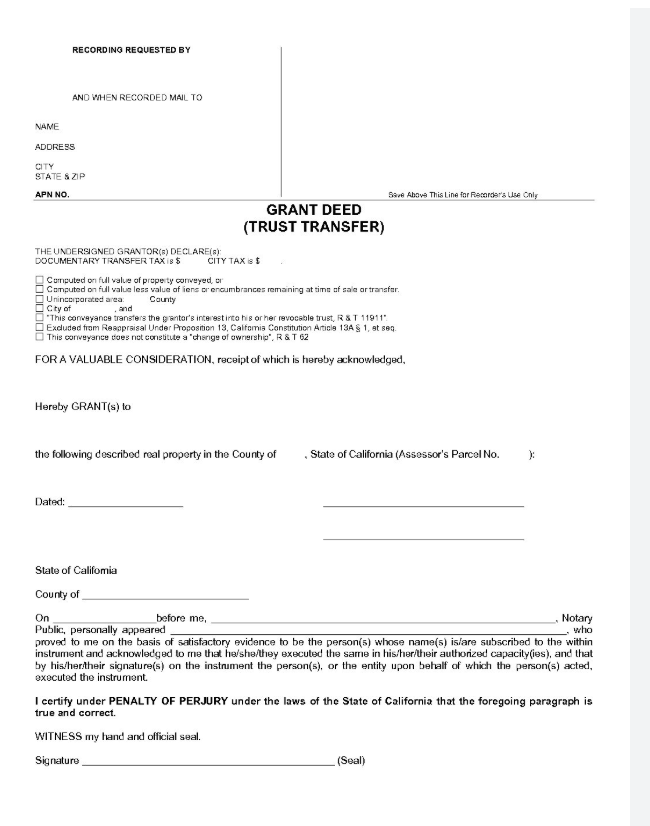
A blank California trust transfer deed form, shown for illustration.
Quick Answer: How Do I Put My California Home Into My Living Trust?
- You sign a trust transfer deed that grants the home from you, as owner, to you as trustee of your trust.
- Everyone on record title signs exactly as their name appears on your current vesting deed.
- Married, but only one spouse on title, and you want a joint trust? Two deeds, in order: an interspousal transfer grant deed first, then the trust transfer deed.
- Each deed is recorded with its own Preliminary Change of Ownership Report (PCOR).
- You record it yourself with your county recorder, after signing before a notary.
- Property taxes: a transfer into your revocable trust is not a change in ownership (Revenue and Taxation Code 62(d)).
Our attorney-prepared trust transfer deed is $100 per property, added to your living trust.
A California living trust is a set of instructions for property the trust owns. Signing the trust does not move your house into it. Until a deed transfers the home to you as trustee, the house stays in your own name, outside the trust. This article covers that deed: what it is, which deed or deeds your situation needs, and what you take to the county recorder.
What a Trust Transfer Deed Does
A trust transfer deed is a grant deed in which you, the current owner, grant the property to yourself as trustee of your living trust. The deed names the trust and its date. You keep living in your home as before.
What changes is record title. Once the deed is recorded, the county records show the trustee of your trust as the owner, and the home is covered by your trust's instructions for incapacity and death.
The rule that trips people up: signers must match record title
The person or people signing the trust transfer deed must match record title exactly, as shown on the current vesting deed, the deed by which you acquired the home. If the vesting deed says "Maria L. Lopez," she signs as Maria L. Lopez, not "Maria Lopez." If two people are on title, both sign. Before anything is prepared, pull a copy of the current vesting deed and check each name and how title is held.
Which Deed Do I Need?
Find your situation in the table. The count shows how many deeds are recorded, and each deed goes to the recorder with its own PCOR.
| Your situation | Deeds needed, in order | Who signs | PCORs | Property tax |
|---|---|---|---|---|
| You are the only person on title and the home goes into your trust. | 1 deed Trust transfer deed. |
You, exactly as your name appears on the vesting deed. | One PCOR with the deed. | Not a change in ownership: transfer into a revocable trust (RTC 62(d)). |
| Both spouses are on title and the home goes into your joint trust. | 1 deed Trust transfer deed. |
Both spouses, each exactly as on the vesting deed. | One PCOR with the deed. | Not a change in ownership (RTC 62(d)). |
| You are married, only one spouse is on title, and you want the home in your joint trust. | 2 deeds First: interspousal transfer grant deed putting both spouses on title. Second: trust transfer deed into the joint trust. |
Deed 1: both spouses. The spouse on title signs as grantor, exactly as on the vesting deed, and the other spouse signs as well. Deed 2: both spouses, as named on deed 1. |
Two PCORs: one with each deed, recorded in that order. | Deed 1: an interspousal transfer is not a change of ownership (RTC 63). Deed 2: not a change in ownership (RTC 62(d)). |
| You own more than one California property. | 1 per property A separate trust transfer deed for each property (and the two-deed order above for any property that needs it). |
Whoever is on record title for that property. | One PCOR with each deed. | Same rules as above, property by property. |
Why two deeds, and why that order
A trust transfer deed can only be signed by the people on record title. If the home is in one spouse's name and the couple's joint trust is meant to hold it, the first deed puts both spouses on title, and only then can both of them sign the trust transfer deed. Both spouses sign that first deed before a notary: the spouse on title as grantor, and the other spouse as well. Record them in that order, each with its own PCOR, so the county records show the chain: one spouse, then both spouses, then the trustee.
Property Taxes: Not a Change in Ownership
Two sections of the Revenue and Taxation Code say these deeds are not a change in ownership:
- Transfers into your trust. Section 62(d) excludes "[a]ny transfer by the trustor, or by the trustor's spouse or registered domestic partner, or by both, into a trust for so long as (1) the transferor is the present beneficiary of the trust, or (2) the trust is revocable." A standard revocable living trust meets that test.
- Transfers between spouses. Section 63 provides that a change of ownership "shall not include any interspousal transfer," including "[t]he creation, transfer, or termination, solely between spouses, of any coowner's interest." That covers the interspousal transfer grant deed in the two-deed order.
Transfer Tax and Recording Fees
Documentary transfer tax
Revenue and Taxation Code 11930 says the documentary transfer tax does not apply to a deed that transfers real property "by reason of such inter vivos gift or by reason of the death of any person," when the property is "transferred outright to, or in trust for the benefit of, any person or entity." If you move your own home into your own trust as a gift, with nothing paid, this is the section that says the tax does not apply to that deed.
The $75 SB2 fee and the owner-occupier exemption
Government Code 27388.1 adds a recording fee of $75 "per each single transaction per parcel of real property," and the fee "shall not exceed two hundred twenty-five dollars ($225)." Two exemptions matter here:
- A document "recorded in connection with a transfer of real property that is a residential dwelling to an owner-occupier."
- A document recorded in connection with a transfer subject to the documentary transfer tax.
A home you live in may fit the owner-occupier exemption. A rental or other property you do not live in does not fit it, and because a gift into your trust is not subject to the documentary transfer tax under Section 11930, the second exemption does not help either. Expect the $75 fee on those properties. The county recorder decides whether an exemption applies and charges its own recording fees on top.
The PCOR
The Preliminary Change of Ownership Report comes from Revenue and Taxation Code 480.3. The form is completed by the transferee, and it "shall be signed by the transferee or an officer of the transferee" and "shall not be signed by an agent acting for a transferee." For a trust transfer deed, the transferee is you as trustee. Record each deed together with its own completed PCOR.
Section 480.3 also lets the recorder "charge an additional recording fee of twenty dollars ($20)" when "a document evidencing a change in ownership is presented to the recorder for recordation without the concurrent filing of a preliminary change in ownership report." Recording each deed with its own PCOR keeps that question from coming up.
Your Recording Packet Checklist
Work through these in order. If your situation needs two deeds, complete packet 1 and packet 2 and record them in that order.
Confirm record title
- Get a copy of the current vesting deed for each property.
- Write down every name exactly as it appears on record title.
- For the trust transfer deed, confirm the grantors are the people on record title, exactly as on that vesting deed (in the two-deed order, both spouses, as named on the interspousal transfer grant deed).
- For the trust transfer deed, confirm the grantee is the trustee of your trust, with the trust's name and date as shown in your trust.
- For an interspousal transfer grant deed, confirm the grantor is the spouse on title, exactly as on the vesting deed, and the grantees are both spouses.
- If only one spouse is on title and the home is going into a joint trust, confirm you have both deeds: the interspousal transfer grant deed and the trust transfer deed.
Interspousal transfer grant deed
- Both spouses sign before a notary public: the spouse on title as grantor, exactly as named on the vesting deed, and the other spouse as well.
- A completed PCOR for this deed, signed by the transferee.
- Record it first.
Trust transfer deed
- Everyone on record title signs before a notary public, exactly as their names appear on record title.
- A completed PCOR for this deed, signed by you as trustee.
- The county's recording fees, and the $75 SB2 fee unless an exemption applies.
- Record it with your county recorder, after packet 1 if you have one.
Keep the proof
- Keep the recorded deed, with its recording information, with your trust documents.
- List the property on your trust's schedule of assets if it is not there already.
- Repeat for each additional California property.
Common Mistakes
- Signing with a different version of your name than the one on record title.
- Leaving someone on title off the deed. Everyone on record title signs.
- Skipping the first deed when only one spouse is on title and the home is meant for the joint trust.
- Recording the two deeds out of order, or with one PCOR for both.
- Signing the trust but never recording a deed. The home then stays outside the trust.
Have the deed prepared with your trust
Our attorney-prepared trust transfer deed is $100 per property, added to your living trust ($400 individual, $500 couple). You sign it before a notary and record it yourself with your county recorder, together with its PCOR, and pay the county's fees.
If only one spouse is on title and the home is going into your joint trust, the interspousal transfer grant deed comes first. Call (818) 337-4071 to order it with your trust.
Frequently Asked Questions
What is a trust transfer deed in California?
It is the deed that moves your California home from your own name into your living trust. You, as owner, grant the property to yourself as trustee of your trust. For a home, the transfer into the trust is made with a deed that you sign before a notary and record with your county recorder.
Is putting my house in my living trust a change in ownership for property tax?
Revenue and Taxation Code 62(d) says a transfer into a trust is not a change in ownership for so long as the transferor is the present beneficiary of the trust or the trust is revocable. A standard revocable living trust meets that test.
Is there a documentary transfer tax on a trust transfer deed?
Revenue and Taxation Code 11930 says the tax does not apply to a deed that transfers real property by reason of an inter vivos gift or by reason of death, outright to or in trust for the benefit of any person or entity. If you move your own home into your own trust as a gift, with nothing paid, this is the section that says the tax does not apply to that deed.
Do I have to pay the $75 SB2 recording fee?
Government Code 27388.1 charges $75 per single transaction per parcel, up to $225. It exempts a document recorded in connection with a transfer of real property that is a residential dwelling to an owner-occupier. A home you live in may qualify; a rental or other property you do not live in does not fit that exemption. The county recorder decides whether an exemption applies.
Only one of us is on title. How do we put the house in our joint trust?
Two deeds, in order. First, an interspousal transfer grant deed, signed by both spouses before a notary (the spouse on title as grantor, exactly as on the vesting deed, and the other spouse as well), puts both spouses on title. Second, the trust transfer deed, signed by both spouses, moves the home into the joint trust. Each deed is recorded with its own PCOR, the interspousal deed first.
Who records the trust transfer deed?
You do. After signing before a notary, you record the deed together with its PCOR with your county recorder and pay the county's recording fees.
How much does a trust transfer deed cost with Living Trust California?
$100 per property for an attorney-prepared trust transfer deed, added to your living trust. You sign it before a notary and record it yourself with your county recorder, together with the PCOR.
Disclaimer
Information on this page is for educational purposes and does not constitute legal advice.
For advice on your specific situation, consult a licensed California estate planning attorney.
About: Rozsa Gyene, California Estate Planning Attorney, State Bar #208356, 25+ years experience. Practice focused on California living trusts, probate, and estate administration.