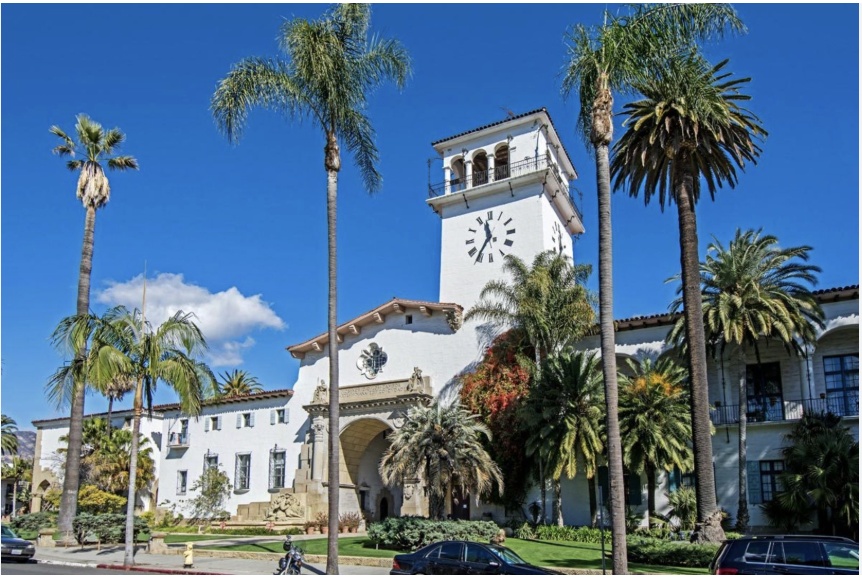
Santa Barbara Living Trust: Protecting the American Riviera
Reviewed by Rozsa Gyene, California attorney. Last reviewed October 2026.
A Santa Barbara probate is filed a few blocks from State Street, at the Anacapa Division of the county Superior Court. On Zillow's typical City of Santa Barbara home value of $1,824,406, the statutory attorney and executor fees alone come to $62,488.12. A funded living trust keeps the assets it holds out of that courthouse.
A Santa Barbara house stays out of probate when it is held in a revocable living trust and a trust transfer deed is recorded at the county Hall of Records. A house left in your own name goes through the Anacapa Division at 1100 Anacapa St., and on Zillow's typical city value of $1,824,406 the ordinary attorney and executor fees under Probate Code §§10810 and 10800 add up to $62,488.12 before court costs. An attorney-prepared trust is $400 for one person or $500 for a couple.
Key Takeaways
South County probate, which includes the City of Santa Barbara, is heard Thursdays at 9:00 a.m. in Dept. SB 5 of the Anacapa Division, 1100 Anacapa St.
Zillow's typical City of Santa Barbara home value was $1,824,406 on August 31, 2026, up from $1,745,015 a year earlier. That is well above the $750,000 limit for the simpler §13151 petition.
Deeds are recorded at the Hall of Records on the same 1100 Anacapa St. block, or in Santa Maria, or by mail. The county wants a signed Documentary Transfer Tax Affidavit whenever no transfer tax is paid.
The city's own transfer tax ordinance takes only the city share of the county rate, so a sale inside the city pays $1.10 per $1,000 in total. A deed to your own revocable trust pays nothing, because the city tax reaches only realty sold (SBMC §4.20.020).
Most households in the city rent. If you own a rental, a duplex or an ADU, plan for the SB 2 fee on the deed and for Prop 19, which does not cover rental property.
$400 for one person, $500 for a couple; a deed is $100 per property.
Santa Barbara County Probate at the Anacapa Division
Courthouse
Santa Barbara County Superior Court, Anacapa Division
Address
1100 Anacapa St., Santa Barbara, CA 93101 (mail: P.O. Box 21107, Santa Barbara, CA 93121)
Phone
Probate clerk (805) 882-4520, 9:00 a.m. to 3:00 p.m., Monday through Friday except holidays
Probate department
South County probate calendar: Dept. SB 5, Thursdays at 9:00 a.m.
The City of Santa Barbara is the county seat, and its probate court is downtown. The Superior Court divides probate between two courthouses. South County estates, from Carpinteria through the city to Goleta, are heard at the Anacapa Division downtown. North County estates go to the Cook Division at 312 E. Cook St. in Santa Maria, which hears probate on Mondays, Tuesdays and Wednesdays in Depts. SM 4, SM 2 and SM 1. Hope Ranch, which has a Santa Barbara address but lies outside the city limits, is a South County community as well.
Before a petition reaches the judge, a probate examiner reads it. The court posts the examiner's probate notes on its Tentative Rulings page about one week before the hearing. Problems are fixed by a verified supplement or amendment, and papers filed after 5:00 p.m. three court days before the hearing may not be considered. For South County matters only, the court lets you email the examiner to clarify a specific posted note. Its probate page also says all documents are to be filed electronically under Local Rule 1012.
A probate also needs a published notice in a newspaper on the court's list of papers adjudged for legal advertising, and an appraisal of everything other than cash by a probate referee appointed by the State Controller. The court's page names three referees for the county, based in Lompoc, Orcutt and Solvang. The first petition costs $435 to file, the statewide fee for 2026, and creditors have four months after letters issue to make claims (Probate Code §9100), so no estate here closes faster than that. For assets held in a funded trust, none of these steps apply.
Recording a Santa Barbara Trust Transfer Deed
Recorder
Santa Barbara County Clerk-Recorder
Address
Hall of Records, 1100 Anacapa St., Santa Barbara, CA 93101. North County office: 511 Lakeside Parkway, Suite 115, Santa Maria, CA 93455. Mail: P.O. Box 159, Santa Barbara, CA 93102.
Phone
(805) 568-2250. Both offices are open 8:00 a.m. to 4:30 p.m. on weekdays, and the county asks you to arrive by 4:00 p.m.
Recording fee
$14 base fee for a document on standard 8.5 by 11 inch pages and $3 for each additional page (county fee page, checked October 6, 2026). A $10 real estate fraud fee applies to the document types on the county's list.
SB 2 fee
The $75 SB 2 fee is usually not charged on a deed moving your own home into your trust because the owner-occupier exemption is claimed on the deed (Government Code §27388.1(a)(2)). It is charged on rentals, second homes and vacant land, capped at $225 per transaction.
PCOR
File a Preliminary Change of Ownership Report (BOE-502-A) with the deed. When the county requires one and it is missing, it collects an extra $20 (R&T §480.3) and the Assessor follows up later. The county's PCOR page lists a trust transfer deed with straightforward names among documents that do not need one; filing it anyway avoids the question.
The Clerk-Recorder's South County counter is in the Hall of Records, part of the same 1100 Anacapa St. block as the Anacapa courthouse. Older listings give 105 E. Anapamu St., Room 204, but the county's directory shows that as the Assessor's office ((805) 568-2550), not the recording counter. A deed presented in person that meets the county's rules is usually recorded while you wait; the county keeps the original for scanning and mails it back, usually within 15 business days. Mailed deeds are processed within 7 to 10 business days, and a rejected deed comes back unrecorded with the reason. Two local rules trip people up: a county ordinance requires the Assessor's Parcel Number on every deed, and the first page needs a 2.5 inch blank margin at the top.
Transfer tax inside the city limits
Some California charter cities charge a large transfer tax of their own on top of the county's. Santa Barbara is a charter city, but it does not. Its Real Property Transfer Tax Ordinance, Santa Barbara Municipal Code chapter 4.20, adopted in 1967, imposes 27.5 cents per $500 under the state Documentary Transfer Tax Act and is administered by the county. California City Finance's table of city transfer tax rates (effective December 1, 2025) lists the City of Santa Barbara at $0.55 per $1,000 with a total of $1.10 per $1,000, the same total as the county's own $0.55 per $500 that applies everywhere else in the county. On a deed into your own trust, none of that matters: documentary transfer tax is $0.00 on a transfer into the grantor's own revocable trust (R&T §11930), and the city ordinance, adopted under the same state law (SBMC §4.20.010), taxes only deeds of realty sold, valued without any loan that stays on the property (SBMC §4.20.020). Santa Barbara County is strict about showing it, though. When no tax is paid, it wants a completed Documentary Transfer Tax Affidavit signed under penalty of perjury with the deed.
The transfer is also not a change in ownership under Revenue and Taxation Code §62(d), so the Assessor does not reappraise the property. The county's PCOR page notes that the PCOR is not a public record; the original goes to the Assessor. Recording fees are changing statewide: AB 2224 (Stats. 2026, ch. 292) sets the statutory base recording fee at $15 for the first page and $4 for each additional page starting January 1, 2027. County add-on fees still apply, so the Santa Barbara County total may differ. Our office prepares the deed for $100 per property, and you record it yourself downtown, in Santa Maria or by mail.
What Probate Would Cost on a Typical Santa Barbara Home
Zillow's typical home value for the City of Santa Barbara was $1,824,406 on August 31, 2026 (Zillow Home Value Index, all homes, middle tier). A year earlier it was $1,745,015. This is a city-wide figure covering condos and houses together; a house on the Riviera or the Mesa can be worth much more, and a condo downtown less. California sets the ordinary attorney fee in Probate Code §10810 as 4% of the first $100,000, 3% of the next $100,000, 2% of the next $800,000 and 1% of the next $9,000,000, with a 0.5% tier above that. The executor is paid the same amount under §10800. The base is the gross value of the estate, not the equity, so a mortgage does not lower it.
Court filing fee: $435 for the first petition (statewide fee; Santa Barbara County adds no surcharge).
Probate referee: one-tenth of one percent of the appraised property (Probate Code §8961), about $1,824 on this home.
Creditor period: four months after letters issue (Probate Code §9100).
The court can also award extra fees for extraordinary services, such as selling the house or handling a lawsuit (Probate Code §§10801 and 10811). For the full explanation see California probate fees explained. The two shortcuts in the Probate Code do not reach a typical Santa Barbara home: the §13151 petition covers a primary residence worth up to $750,000 (deaths on or after April 1, 2025), and the §13100 affidavit collects personal property only when the estate, real property included, is $208,850 or less. Compare the $62,488.12 with a $400 trust for one person or $500 for a couple.
Santa Barbara Property and What It Means for Your Trust
A city of renters, and of small rental buildings
The 2020 Census counted 88,665 people in the City of Santa Barbara, in 38,208 housing units. Owners are the minority: the Census Bureau's 2024 American Community Survey estimates that 15,221 of 36,779 occupied homes, about 41%, were owner-occupied. The housing stock is older and more mixed than in the county as a whole. The same survey puts the city's median year built at 1967 (1975 countywide) and counts fewer than half of the city's units (18,749 of 41,372) as detached single-family houses, against about 56% countywide, with thousands more in duplexes, three and four unit buildings and small apartment buildings.
That matters for a trust in three ways. First, a building you rent out does not fit the owner-occupier exemption from the $75 SB 2 fee, so expect the fee on that deed. Second, Prop 19's parent to child exclusion does not cover rental property at all; if your children inherit a fourplex, it is reassessed. Third, a lease does not end when the landlord dies. The successor trustee collects the rent, deals with the tenants and keeps the insurance in force, and the trust can say whether the building is kept or sold. List every rental on the questionnaire, including any unit you rent in your own house.
ADUs on the same lot
An accessory dwelling unit built on your lot is part of the same parcel, so it goes into the trust on the same deed as the main house. There is no separate deed for the ADU. The questions are about use, not title: if the ADU is rented, the trust should say who receives the rent after your death, and the successor trustee needs the lease and the permits to manage or sell the property.
El Pueblo Viejo, City Landmarks and the Mills Act
The city created El Pueblo Viejo by resolution in September 1959, and the City Council formally established the district by ordinance in March 1960. Part I surrounds the Royal Presidio, the State Street commercial corridor and Cabrillo Boulevard along the beach; Part II surrounds the Mission. Every property in the district is under the Historic Landmarks Commission's jurisdiction for alterations and new construction, and the city says a building over 50 years old in the district is likely a contributing historic resource. Putting a house in your trust does not change any of that design review. It changes only who signs the application: your trustee instead of you.
Owners of a City Landmark, a City Structure of Merit or another listed historic building can apply for a Mills Act contract, which the city says reduces property taxes by 40 to 60 percent on average in exchange for restoration and maintenance. Applications run from January 1 to June 30, and the city caps the program at $260,000 a year in lost revenue. Two features of the contract affect estate planning. The contract is recorded with the County Recorder and is binding on successor owners, so it stays with the house through your trust and on to your beneficiaries. And cancelling it can cost a penalty of 12.5 percent of the property's assessed market value. Keep the recorded contract and your annual reports to the city with your trust papers so the successor trustee knows the obligation exists. The program covers only property inside the city; the city's packet says it has no jurisdiction over unincorporated land.
Inside or outside the city limits
A Santa Barbara mailing address does not always mean the City of Santa Barbara. Hope Ranch and Mission Canyon, for example, are unincorporated parts of the county. For your trust the court, the recorder and the assessor are the same either way. What changes is the city layer: the city's historic districts and its Mills Act program apply only inside the city limits. The Assessor's Parcel Number on your current deed, which has to go on the new deed anyway, lets the county confirm where the parcel sits.
Fire history and insurance
The city's foothills have burned repeatedly. The City of Santa Barbara's list of historical area fires counts 524 homes lost in the 1990 Painted Cave Fire, which a Sundowner wind drove into the city, 210 in the 2008 Tea Fire in the foothills of Santa Barbara and Montecito, and 160 in the 2009 Jesusita Fire above San Roque. Counts differ by source: CAL FIRE's incident record for the Jesusita Fire lists 80 homes and 79 outbuildings destroyed. A trust does nothing about fire risk, but after the deed records, ask your insurer to list the trustee as an insured so a claim or renewal is not held up by a title question. Keep permits and any rebuild records with the trust, because a successor trustee selling or insuring the house will need them.
An older population and incapacity planning
In the 2020 Census, 20.1% of city residents were 65 or older, and in 14.3% of households someone 65 or older lived alone. For those owners the incapacity side of the plan matters as much as probate. The successor trustee can manage trust property if you cannot, without a court conservatorship, and the durable power of attorney and advance health care directive in the package cover what the trust does not, such as retirement accounts and medical decisions.
Prop 19 for children who inherit
An owner who bought decades ago may have a Prop 13 taxable value far below today's market. Prop 19 limits what children keep. The exclusion applies only to a family home that was the parent's principal residence and becomes the child's principal residence, with the homeowners' exemption filed within one year. Even then, any market value above the factored base year value plus $1,044,586 (for transfers from February 16, 2025 to February 15, 2027) is added to the taxable value. A hypothetical using this page's figure: if the home were worth exactly the typical value of $1,824,406 on the date of the transfer, and the parent's factored base year value were anything below $779,820, the child's new taxable value would be $1,824,406 minus $1,044,586, or $779,820. If no child moves in, or the property is a rental, it is reassessed in full. The claim form, BOE-19-P, is due within three years. A trust does not change these rules, but the trustee can act on them without waiting for a probate court.
What stays private
Probate is a public court case, including the inventory of what the person owned. A trust is usually settled without a court filing, but it is not secret: the recorded deed names the trustee, and after a death the trustee must notify the beneficiaries and heirs within 60 days of the death, or of the day the successor starts serving if the death left the trustee's office vacant (Probate Code §16061.7). Banks and title companies can rely on a short certification of trust under Probate Code §18100.5 instead of reading the whole document. While you are alive, a revocable trust does not shield your assets from your own creditors (Probate Code §18200).
How to Create and Fund a Living Trust in Santa Barbara
Answer the questionnaireComplete the online questionnaire with your Santa Barbara property, your accounts, your successor trustees and your beneficiaries. Mention any rental units or ADU, any Mills Act contract and any property outside the city limits or outside California.
Attorney review and signingRozsa Gyene, a California attorney, drafts the trust and the deed from your answers and reviews them. Sign the trust and the deed in front of a notary, in Santa Barbara or anywhere in California, and sign the pour-over will with two witnesses present.
Record the deed in Santa Barbara CountyTake the signed deed to the Clerk-Recorder counter in the Hall of Records at 1100 Anacapa St. or the Santa Maria office, or mail it to P.O. Box 159. Put the Assessor's Parcel Number on the deed and include a Preliminary Change of Ownership Report (BOE-502-A) and the county's Documentary Transfer Tax Affidavit showing no tax due.
Retitle bank and brokerage accountsMove checking, savings and investment accounts into the trustee's name one institution at a time. Most institutions accept the certification of trust in place of the full trust document.
Review beneficiary designationsAn IRA, a 401(k), an annuity or a life insurance policy goes to whoever is named on its own beneficiary form, whatever the trust says. Check each form against your plan, and get advice before naming the trust as beneficiary of a retirement account.
Tell your insurer and keep the papers togetherAsk your homeowners or landlord insurer to add the trustee as an insured after the deed records, and keep the recorded deed, the certification of trust, any leases and any Mills Act contract with the trust.
Advance health care directive with HIPAA authorization
Certification of trust
Assignment of personal property
Personal property memorandum
Funding instructions
Santa Barbara clients pay $400 for one person or $500 for a married couple. A deed for your house, a rental building or any other California property is $100 per property, and you record it with the Santa Barbara County Clerk-Recorder. You can call the attorney's office directly at (818) 337-4071 and sign before any California notary in Santa Barbara. For how the price compares, see what a California living trust costs.
Santa Barbara Living Trust Questions
How much would probate cost on a typical Santa Barbara home?
Zillow put the typical home value in the City of Santa Barbara at $1,824,406 on August 31, 2026. On that value the ordinary attorney fee under Probate Code §10810 is $31,244.06, and the executor is entitled to the same amount under §10800, so together they come to $62,488.12. The fee is figured on the gross value of the property, so a mortgage does not reduce it. The $435 filing fee, the probate referee, newspaper publication and any extraordinary fees come on top.
Where is probate heard for a Santa Barbara estate?
Santa Barbara is in the South County half of the county, so the case is filed with the Superior Court and heard at the Anacapa Division, 1100 Anacapa St., Santa Barbara. The court lists the South County probate calendar on Thursdays at 9:00 a.m. in Dept. SB 5, and the probate clerk's number is (805) 882-4520. North County estates go to the Cook Division in Santa Maria instead.
Where do I record a Santa Barbara trust transfer deed, and what does it cost?
The Santa Barbara County Clerk-Recorder records deeds at the Hall of Records, 1100 Anacapa St., and at 511 Lakeside Parkway, Suite 115, in Santa Maria, and takes mail at P.O. Box 159, Santa Barbara, CA 93102. The county fee page lists $14 for a document with standard pages and $3 for each additional page. The $75 SB 2 fee is usually not charged on a deed moving your own home into your trust because the owner-occupier exemption is claimed on the deed; it is charged on rentals, second homes and vacant land, capped at $225 per transaction.
Does the City of Santa Barbara charge its own transfer tax when I deed my house to my trust?
No tax is due on that deed. The city does have a transfer tax ordinance, Municipal Code chapter 4.20, at 27.5 cents per $500, which is the city share allowed under the state Documentary Transfer Tax Act and is administered by the county. Unlike Los Angeles or Oakland, Santa Barbara adds no larger city rate, so a taxable sale inside the city pays $1.10 per $1,000 in total, the same as in unincorporated areas. The city ordinance is adopted under Part 6.7 of Division 2 of the Revenue and Taxation Code (SBMC §4.20.010) and taxes only deeds of realty sold, valued without any loan that stays on the property (SBMC §4.20.020), so a transfer into your own revocable trust pays $0.00 in city tax, and $0.00 in county tax under R&T §11930. The county asks for its signed Documentary Transfer Tax Affidavit with the deed.
My house has a Mills Act contract. What happens when I put it in my trust?
The contract stays with the house. The City of Santa Barbara records its Mills Act contracts with the County Recorder and says the contract is binding on successor owners, so your trust holds the house subject to it and your successor trustee inherits the duty to keep up the restoration and maintenance plan. A transfer into your own revocable trust is not a change in ownership for property tax (R&T §62(d)). The City also says new owners must sign a maintenance agreement, so ask its Architectural Historian whether it wants anything from you after the deed to your trust records.
What happens under Prop 19 if our children inherit our Santa Barbara home?
The parent to child exclusion applies only if the home was your principal residence and a child moves in and files for the homeowners' exemption within one year. Even then, value above the old taxable value plus $1,044,586 is added. For example, if the home were worth the typical value of $1,824,406 on the date of the transfer and your taxable value were below $779,820, the child's new taxable value would be $779,820, which is $1,824,406 minus $1,044,586. A rental or second home does not qualify.
Can my trust hold my ADU and the rent from it?
Yes. An accessory dwelling unit on your lot is part of the same parcel, so the deed that moves the house into the trust moves the ADU with it. Your trust says who receives the rent after your death, and until the property is distributed or sold the successor trustee collects it and acts as landlord. The tenant's lease does not end because the owner dies. If the ADU or any other unit is rented, the $75 SB 2 fee may apply to the deed, depending on how the property is used.
Keep Your Santa Barbara Home Out of the Anacapa Courthouse
Answer the questionnaire online, and a California attorney prepares your trust, will and powers, with a deed for each Santa Barbara property if you want one.