Frequently Asked Questions
How much does an online living trust cost in California?
An online living trust in California costs $400-$500 for attorney-reviewed documents, compared to often several thousand dollars for a traditional attorney. LivingTrustCalifornia.com charges $400 for individuals and $500 for couples, including complete packages with living trust, pour-over will, powers of attorney, and healthcare directives, all reviewed by Attorney Rozsa Gyene, CA Bar #208356.
LegalZoom's $399 trust is software-generated with no attorney; their only attorney plan is the $549 Premium trust ($649 for couples, as of September 2026), with phone consultations through a membership that renews at $199/year (LegalZoom is not a law firm). Our service includes attorney review at no extra cost, to meet California Probate Code requirements.
What's included in $400-$500: Revocable living trust (with schedule of assets), pour-over will, general durable power of attorney, advance health care directive, HIPAA authorization, certification of trust, trustee affidavit, assignment of personal property, and personal property memorandum, plus funding instructions.
Create your California living trust: most people finish the questionnaire in 20 to 30 minutes, and you receive your completed living trust documents within 24 hours.
Can I create my own living trust in California?
Yes, California law allows you to create your own living trust without an attorney. A valid California living trust requires a written document signed by you. California law does not require a living trust to be notarized or witnessed to be valid (Probate Code 15200), but banks and title companies commonly expect a notarized trust or certification of trust. However, errors in a self-made trust can send assets into probate. Online services with attorney review ($400-$500) provide the best balance of affordability and quality.
While completely online trusts are legal, they carry significant risk. California probate courts regularly see failed trusts due to improper execution, unclear beneficiary designations, or missing provisions. Our service provides attorney-quality documents at online prices with mandatory review by Attorney Rozsa Gyene, CA Bar #208356.
Is an online living trust legal in California?
Yes, online living trusts are completely legal in California. The state has no requirement that trusts be prepared by an attorney. As long as the trust document is properly written and signed according to California Probate Code requirements, it is legally valid and enforceable, regardless of who prepared it. California does not require notarization for validity, though banks and title companies commonly expect a notarized trust or certification of trust.
California courts regularly accept trusts created through online services, template methods, and self-preparation. The key is ensuring proper execution and compliance with state law requirements.
How long does it take to create a living trust online?
Most people finish the online questionnaire in 20 to 30 minutes, and you receive your completed living trust documents within 24 hours. Compare this to 2-4 weeks when working with an attorney.
The online process is straightforward: answer questions about your family and assets, review your generated documents, sign and notarize, then fund your trust by transferring assets.
What documents are included in an online living trust package?
A complete online living trust package includes the revocable living trust (with schedule of assets), pour-over will, general durable power of attorney, advance health care directive, HIPAA authorization, certification of trust, trustee affidavit, assignment of personal property, and personal property memorandum, plus funding instructions (property transfer deeds are a separate $100 per property). Living Trust California includes all 9 essential documents for $400 (single) or $500 (couples).
These documents work together to provide comprehensive estate planning: the trust avoids probate, the pour-over will catches missed assets, powers of attorney protect you during incapacity, and healthcare directives ensure your medical wishes are followed.
Note: Will-only packages (without living trust) start at $150 for individuals, $250 for couples.
Do I need a lawyer to create a living trust?
No, California does not require a lawyer to create a living trust. Many people successfully create valid trusts using online services for simple estates. However, if you have business interests, real estate in another state, a beneficiary with special needs, a blended family with competing interests, or an estate near the federal estate tax exemption ($15,000,000 in 2026), consulting an attorney is recommended.
For straightforward estates (married or single, one primary residence, standard beneficiary wishes), online services with attorney review offer the best value. You get attorney-quality documents at a fraction of traditional attorney costs.
What's the cheapest way to get a living trust in California?
The cheapest way to get a living trust in California is using an online service like Living Trust California for $400. Template books and forms cost less but carry a higher risk of errors. LegalZoom's attorney plan (Premium) costs $549 and its Basic trust with no attorney $399 (as of September 2026), traditional attorneys often charge several thousand dollars, and probate without a trust means statutory attorney and executor fees of $26,000 on a $500,000 estate.
Don't confuse "cheapest upfront" with best value. A $400-$500 trust that's properly prepared and attorney-reviewed can save your family $26,000 to $66,000 in statutory probate fees ($500,000 to $2,000,000 estates) and a probate that often takes 12 to 18 months or longer.
Quick Navigation - 60+ Questions Answered
Basics
General Questions (8)Cost & Value
Cost & Pricing (8)Setup
Setup & Process (7)Funding
Funding & Assets (2)California
CA-Specific (5)Online Trusts
Legitimacy & Quality (5)Situations
Specific Situations (3)After Death
After Death Process (5)Because we are a Law Firm, a California attorney prepares and reviews your documents.
General Living Trust Questions
What is a living trust in California?
A living trust (also called a revocable living trust) is a legal document that holds ownership of your assets during your lifetime and distributes them to your beneficiaries after you pass away, all without going through probate court.
How it works:
- You create the trust and transfer your assets into it
- You serve as the trustee and maintain complete control
- You can change, amend, or cancel the trust at any time
- When you die, your successor trustee distributes assets to beneficiaries
- The entire process avoids probate court
A funded living trust is one of the most reliable ways to avoid California's expensive ($26,000-$66,000+ in statutory fees on a $500,000 to $2,000,000 estate) and time-consuming (often 12 to 18 months or longer) probate process.
What's the difference between a living trust and a regular trust?
A living trust (also called an "inter vivos trust") is created during your lifetime, while other trusts may be created after death (testamentary trusts) or for specific purposes.
Key distinctions:
- Living Trust: Created while you're alive, you control it, can be changed anytime, avoids probate
- Testamentary Trust: Created by your will after death, goes through probate first
- Irrevocable Trust: Cannot be changed once created, used for tax/asset protection
- Special Needs Trust: Protects disabled beneficiaries' government benefits
When people say "living trust," they usually mean a revocable living trust - the most common type for estate planning.
How does a living trust work in California?
During your lifetime:
- You create the trust document
- You transfer your assets into the trust (funding)
- You serve as trustee and control everything
- You can buy, sell, mortgage, or manage assets normally
- You can change beneficiaries or trustees anytime
If you become incapacitated:
- Your successor trustee takes over immediately
- No court-appointed conservatorship needed
- Your bills get paid, assets managed
When you die:
- Successor trustee takes control immediately
- Assets distributed to beneficiaries per your instructions
- No probate court involvement
- No wait for probate court (probate often takes 12 to 18 months or longer)
- Everything stays private (not public record)
What are the benefits of a living trust?
Top 8 Benefits:
- Avoids Probate: Save $26,000-$66,000+ in statutory probate fees ($500,000 to $2,000,000 estates) and a probate that often takes 12 to 18 months or longer
- Privacy: Trust stays private vs. probate (public record)
- Incapacity Protection: Successor trustee manages if you can't
- Control: Specify when/how beneficiaries receive assets
- Speed: Distribution without waiting for probate court
- Multi-State Property: One trust covers all states
- Contest-Resistant: Harder to challenge than a will
- Peace of Mind: Know your family is protected
What are the disadvantages of a living trust?
Honest disadvantages to consider:
- Upfront Cost: $400-$500 here, or often several thousand dollars with a traditional attorney (but can save $26,000+ in statutory probate fees later on a $500,000 estate)
- Time to Set Up: most people finish the questionnaire in 20 to 30 minutes (online), or several weeks (attorney)
- Funding Required: Must transfer assets into trust (2-4 hours work)
- Can't Name Guardians: Need separate will for minor children's guardians
- Complexity: Slightly more complex than a simple will
- Ongoing Maintenance: May need updates after major life changes
Is a living trust worth it in California?
Absolutely yes for most California residents. Here's the math:
Example: $500,000 California Estate
- Living trust cost: $400-$500
- Probate cost without trust: $26,000 (statutory fees)
- Additional probate costs: court filing fee ($435) plus appraisal and publication fees
- Time saved: often 12 to 18 months or longer
- Privacy gained: Priceless
You pay $500 and your family avoids $26,000 in statutory probate fees plus court costs
You should get a living trust if:
- ✓ You own California real estate
- ✓ Your assets exceed $208,850
- ✓ You value privacy
- ✓ You want to protect your family from probate
Can I create a living trust myself?
Technically yes, but not recommended. Here's why:
Template Risks:
- Common mistakes: improper funding, invalid notarization, wrong trustee provisions
- One error can cost your family $26,000+ in statutory probate fees on a $500,000 estate
- Mistakes usually discovered after you die - too late to fix
Better Options:
- Online with Attorney Review ($400-$500): Attorney quality at a low flat fee
- Traditional Attorney (often several thousand dollars): For complex estates
- Pure Template ($0-100): Highest risk, not worth the savings
How long does a living trust last?
A living trust lasts forever or until all assets are distributed, whichever comes first.
Timeline:
- During your lifetime: Trust continues indefinitely (you can cancel anytime)
- After your death: Trust continues until successor trustee distributes all assets
- Distribution timeframe: depends on the estate; no probate court involved
- Testamentary trusts: Can continue for beneficiaries (minor children until age 25, 30, etc.)
Example: You die with a $500,000 estate. Your successor trustee inventories assets, pays bills, files final tax returns, and distributes to beneficiaries without going to probate court. The trust then terminates.
Exception: If you set up sub-trusts for minor children that hold money until they reach age 30, those sub-trusts continue until the child reaches that age.
Cost & Pricing Questions
How much does an online living trust cost in California?
Don't confuse "cheapest upfront" with best value. A $400-$500 trust that is properly prepared can save your family $26,000-$66,000 in statutory fees (on a $500,000 to $2,000,000 estate) by avoiding California probate court and its delays, which often run 12 to 18 months or longer.
Check our transparent pricing table to see what is included in our $400 individual and $500 joint trust packages. See our full pricing breakdown here →
Is LegalZoom cheaper than an attorney for a living trust?
Yes, but our service is even more affordable:
| Service | Cost | Attorney Review |
|---|---|---|
| Living Trust California | $400-$500 | ✓ Included |
| LegalZoom Premium | $549-$649 (as of September 2026) | Phone consultations, renew at $199/year |
| Traditional Attorney | Often several thousand dollars | ✓ Included |
You save $149 compared with LegalZoom Premium (as of September 2026)
Our California law firm provides attorney review as standard. See the full breakdown of LDA vs. Law Firm requirements here.
Are there any hidden costs with a living trust?
Beyond the initial trust creation cost, budget for:
- Notarization: $15 per signature for the acknowledgment (Government Code 8211)
- Real Estate Transfer Recording: Recording fees are set by your county and vary; your county recorder's office can tell you the exact amount.
- Optional Title Company Help: fees vary if you use a title company to transfer property
- Future Amendments: call (818) 337-4071 for pricing when you need changes
What's usually free:
- ✓ Bank account transfers
- ✓ Investment account transfers
- ✓ Vehicle transfers (optional - not required)
- ✓ Personal property assignment
Total additional costs: notary fees and your county's recording fee for most people
How much does it cost to amend a living trust in California?
Trust Amendment Costs:
- Living Trust California: call (818) 337-4071 for pricing
When you need an amendment:
- Change beneficiaries
- Change successor trustee
- Add or remove assets
- Update distribution percentages
When you need a full restatement (call for pricing):
- Major life changes (remarriage, divorce)
- Significant asset changes
- Multiple amendments already made
- Complete restructuring
What's cheaper: a will or a living trust?
Upfront cost: A will is cheaper
- Will: $150 here ($250 joint)
- Living Trust: $400-$500 here, or often several thousand dollars (attorney)
Total cost (including after-death costs): A trust is MUCH cheaper
Example: $500,000 California Estate
- With Will Only:
- Will cost: $250
- Probate fees: $26,000
- Plus court costs, appraisal and publication fees
- Total: $26,250 plus court costs
- With Living Trust:
- Trust cost: $500
- Probate fees: $0
- Court costs: $0
- Total: $500
Savings: $25,750 plus court costs
How much does probate cost in California vs a living trust?
California Probate Costs (Statutory Fees):
| Estate Value | Probate Cost | Living Trust | Savings |
|---|---|---|---|
| $300,000 | $18,000 | $500 | $17,500 |
| $500,000 | $26,000 | $500 | $25,500 |
| $1,000,000 | $46,000 | $500 | $45,500 |
Plus these additional probate costs:
- Court filing fees: $435 ($450 in Riverside and San Francisco)
- Publication fees
- Appraisal fees
- Accounting fees
- Time: often 12 to 18 months or longer (no probate with a funded trust)
Do online living trust services really work?
Yes, IF they include attorney review. Here's what matters:
What Makes Online Services Legitimate:
- ✓ California-specific documents (not generic 50-state templates)
- ✓ Attorney-prepared and reviewed (not optional extra)
- ✓ Licensed attorney backing (state bar number provided)
- ✓ Comprehensive package (trust + will + POA + healthcare directive)
- ✓ Proper funding instructions (critical - many trusts are left unfunded)
Red Flags:
- ✗ No attorney review or it costs extra
- ✗ Generic templates not specific to California
- ✗ No state bar number or attorney identification
- ✗ Too cheap ($99 or less - usually inadequate)
Can I afford NOT to have a living trust?
No. Here's the brutal math:
If you own a $400,000 California home:
- Living trust cost: $400-$500 (one-time)
- Probate cost without trust: $11,000 (attorney) + $11,000 (executor) = $22,000 in statutory fees, plus court costs
- Time delay: often 12 to 18 months or longer before your family can access assets
- Privacy lost: All your assets become public record
The question isn't "Can I afford a trust?"
The question is "Can my family afford the $22,000+ and a probate that often takes 12 to 18 months or longer if I DON'T have a trust?"
Do you offer property deed transfer services?
Yes. For $100 per property, we prepare a deed to transfer your real property into your trust. This includes a title search to verify current deed information and an attorney-prepared transfer deed. You receive the completed deed with instructions to record it at your county recorder's office (recording fees are set by your county and vary; your county recorder's office can tell you the exact amount).
Many clients find this helpful because transferring property into a trust requires precise legal language to avoid property tax reassessment or title issues.
What's included in the $100 deed service:
- Title search: We verify current ownership, legal description, and any easements or restrictions
- Attorney-prepared trust transfer deed: Properly formatted to transfer from you individually to you as trustee
- Preliminary change of ownership report: Required form for county recorder
- Recording instructions: Step-by-step guide to file the deed yourself and save recording fees
When to order: Add the deed service when creating your living trust. We'll contact you within 24 hours to collect property details (address, current deed information). Most clients receive their deed within 3-5 business days.
Can I get my estate plan printed and mailed to me?
Yes. For $75, we professionally print your complete estate plan, organize it in an elegant folder with labeled dividers, and mail it directly to you. Your package arrives ready to store or share with your successor trustee, typically within 5-7 business days after document completion.
Many clients prefer a physical copy for peace of mind: keeping a printed set in a fireproof safe, sharing with their successor trustee, or storing with their attorney. While all documents are available for download as PDFs, a professionally organized printed package provides an extra layer of security.
What's included in the $75 printed package:
- Professional printing: All your estate planning documents printed on premium paper
- Elegant presentation folder: Durable folder with your name embossed
- Labeled dividers: Organized sections for Trust, Will, Powers of Attorney, Healthcare Directives
- Quick reference guide: Summary of what each document does and where to find key provisions
- Successor trustee instructions: Step-by-step guide for your trustee
- Secure mailing: Shipped via USPS Priority Mail with tracking
When to order: Add the printed package when completing your order. We mail it after attorney review is complete, typically 5-7 business days after document completion.
Setup & Process Questions
How do I set up a living trust in California?
7-Step Process:
- Decide if you need a trust (Do you own real estate or have assets over $208,850?)
- Choose your successor trustee (Who will manage the trust when you die?)
- Choose your beneficiaries (Who inherits what?)
- Create the trust document (Online: most people finish the questionnaire in 20 to 30 minutes; attorney: 3-6 weeks)
- Sign and notarize (California law does not require notarization for the trust to be valid, but banks and title companies commonly expect it, and any deed must be notarized before it can be recorded)
- Fund the trust (Transfer assets - MOST CRITICAL STEP)
- Update beneficiary designations (Coordinate retirement accounts, life insurance)
Timeframe:
- Online: most people finish the questionnaire in 20 to 30 minutes; 2-4 hours to fund
- Attorney: 3-6 weeks to create, 2-4 hours to fund
How long does it take to create a living trust?
Creation Time:
- Online Service: most people finish the questionnaire in 20 to 30 minutes; you receive your completed documents within 24 hours
- Attorney: 3-6 weeks (initial meeting, drafting, review meeting, signing)
Funding Time (Most Important):
- Simple estate: 2-4 hours (bank accounts, 1-2 properties)
- Complex estate: 1-2 weeks (multiple properties, businesses, investments)
Total Time:
- Online: most people finish the questionnaire in 20 to 30 minutes, receive documents within 24 hours, then fund the trust
- Attorney: 4-8 weeks start to finish
What documents do I need to create a living trust?
Documents You'll Create:
- Living Trust Agreement (the main document)
- Pour-Over Will (catches unfunded assets)
- Durable Power of Attorney (financial decisions if incapacitated)
- Advance Healthcare Directive (medical decisions)
- Assignment of Personal Property (transfers personal items)
Information You'll Need:
- Full legal names and addresses
- Successor trustee information
- Beneficiaries' names, addresses, relationships
- List of assets (real estate, accounts, valuable property)
- Guardian preferences (if minor children)
After Creation, You'll Need:
- Property deeds (to transfer real estate)
- Bank/investment account information
- Business ownership documents
Do I need a lawyer to create a living trust in California?
No, but attorney review is highly recommended.
Your Options:
- Online with Attorney Review ($400-$500):
- ✓ Attorney quality at a fraction of the cost
- ✓ California-specific documents
- ✓ Attorney reviews for errors
- ✓ Backed by licensed CA attorney
- ✓ Suitable for many California families
- Traditional Attorney (often several thousand dollars):
- ✓ Best for complex estates (business interests, real estate in another state, a beneficiary with special needs, a blended family with competing interests, or an estate near the federal estate tax exemption ($15,000,000 in 2026))
- ✓ Personalized advice
- ✓ Advanced tax planning
- ✗ Takes 3-6 weeks
- Template Without Attorney ($0-100):
- ✗ Mistakes not discovered until after death
- ✗ Can cost family $26,000+ in statutory probate fees ($500,000 estate)
- ✗ Not worth the risk
Can I create a living trust online in California?
Yes! Online living trusts are:
- ✓ Legal and valid in California (if properly prepared)
- ✓ Attorney-backed (when created by licensed CA attorney)
- ✓ Much faster (most people finish the questionnaire in 20 to 30 minutes, vs 3-6 weeks)
- ✓ Much cheaper ($400-$500 vs often several thousand dollars)
- ✓ Just as effective (same legal protection)
Requirements for Valid Online Trust:
- Must be California-specific (not generic 50-state template)
- Must include attorney review
- Should be properly notarized (not required for validity, but banks and title companies commonly expect it)
- Must be properly funded (assets transferred)
- Should be backed by licensed CA attorney (state bar number)
When to Use Attorney Instead:
- Estate near the federal estate tax exemption ($15,000,000 in 2026)
- Own a business
- Complex family (blended family, special needs beneficiary)
- Multiple properties in different states
- Need advanced tax planning
Does a living trust need to be notarized in California?
No. California law does not require a living trust to be notarized or witnessed to be valid (Probate Code 15200). In practice, notarization is strongly recommended.
Here's why you need notarization:
- Real estate transfers: Deeds MUST be notarized to record with county
- Bank acceptance: Most banks require notarization to change account titles
- Proof of authenticity: Notarization proves you signed it
- Prevents challenges: Much harder to contest a notarized trust
- Institutions expect it: Banks, title companies and other institutions commonly expect a notarized trust or certification of trust
What needs notarization:
- ✓ Living trust document (your signature as trustee)
- ✗ Pour-over will: no notary needed; two witnesses sign it instead (Probate Code §6110)
- ✓ Durable power of attorney (your signature)
- ✓ Healthcare directive (your signature)
- ✓ Real estate deeds (your signature)
Cost: $15 per signature in California (notary fee)
Total notary cost for complete estate plan: $60-$120
What's the difference between a living trust and a will?
The short answer: A California Will instructs probate court how to distribute assets and often takes 12 to 18 months or longer. A Living Trust holds title to your assets during your life, avoiding probate court for the assets it holds, with private distribution after death.
Key Differences:
| Feature | California Will | Living Trust |
|---|---|---|
| Probate Required? | Yes (if assets exceed $208,850) | No |
| Timeline | Often 12 to 18 months or longer | No probate court |
| Privacy | Public record | Private |
| Cost to Family | $26,000-$66,000+ in statutory fees ($500K to $2M estates) | $0 probate fees |
Funding & Asset Questions
How do I include my house in my living trust?
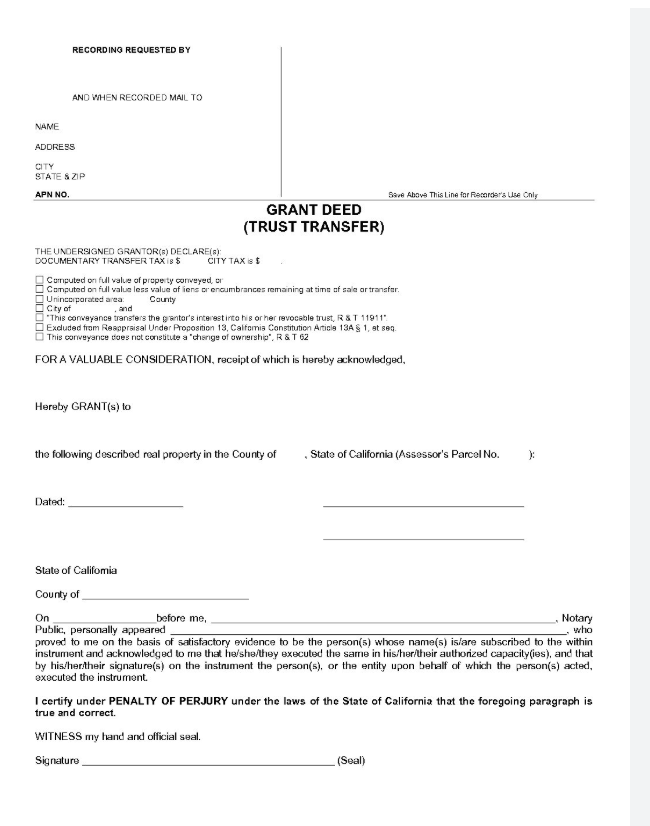
To include your house in your living trust, you must sign and record a new deed transferring ownership from your name to your trust's name.
Step-by-step process:
- Obtain current deed from county recorder (free online in most counties)
- Prepare a trust transfer deed transferring to your trust
- Sign the deed in front of a notary ($15 fee)
- Record the deed with your county recorder's office. Recording fees are set by your county and vary; your county recorder's office can tell you the exact amount.
- Send copy to your mortgage lender (does NOT trigger due-on-sale clause)
"Funding is where online trusts fail. I see many people create a trust document but forget to actually record the new deed for their house. If the deed isn't recorded, the house still goes through probate. Don't skip this step. Our package includes the instructions you need."
Can I put my rental property in a living trust?
Yes, you can and should put rental property in your living trust. Rental properties transfer to your trust the same way as your primary residence - through a recorded deed. Rental properties in a trust avoid probate, provide liability protection continuity, and ensure seamless management if you become incapacitated. The transfer does not affect your tax treatment, depreciation schedules, or mortgage terms.
Benefits for rental properties:
- Probate avoidance: Your heirs receive the property without going to probate court, rental income continues uninterrupted
- Incapacity protection: Successor trustee can manage property and collect rent if you're unable
- Privacy: Property ownership and value stay private (not in probate court records)
- Continuity: Leases remain valid, tenants experience no disruption
Tax treatment: Rental property in a revocable living trust continues to be reported on Schedule E of your personal tax return. No new tax ID number needed, no change to depreciation, same 1031 exchange eligibility. The IRS treats you and your revocable trust as the same entity for tax purposes.
Deed preparation for California real estate, including rental properties, is a separate $100 per property. You record the deed with your county recorder.
California-Specific Questions
What is the California small estate limit for avoiding probate?
California's small estate limit is $208,850 (effective April 1, 2025; adjusted every three years for inflation from the base $166,250 under Prob. Code §890). If your estate's total gross value is under $208,850, your heirs can use a simplified small estate affidavit procedure to claim assets without formal probate. However, the small estate affidavit does not transfer real estate. A house does not always need full probate: for deaths on or after April 1, 2025, a primary residence worth up to $750,000 can pass by a court petition under Probate Code 13151, which is simpler than full probate but still a court filing. Homes over $750,000, and real property that was not the primary residence (above $69,625), generally need full probate unless held in a trust or passing another way.
What counts toward the $208,850 limit:
- Bank accounts (checking, savings, CDs)
- Investment accounts (stocks, bonds, mutual funds)
- Personal property (jewelry, furniture, collectibles)
- Business interests
- Life insurance payable to estate (not to named beneficiary)
What does NOT count (exempt from the limit):
- ❌ Real estate is not exempt: California real estate counts toward the limit unless it passes by a Probate Code 13151 court petition (a primary residence up to $750,000). The affidavit itself cannot transfer real property; real property up to $69,625 can pass by affidavit under Probate Code 13200.
- ✓ Joint tenancy property (passes automatically to surviving owner)
- ✓ Payable-on-death accounts (go directly to named beneficiary)
- ✓ Life insurance with named beneficiary
- ✓ Retirement accounts with named beneficiary (IRA, 401k)
- ✓ Trust assets (already avoid probate)
- ✓ Registered vehicles, vessels and mobilehomes (Probate Code §13050(b))
How much does California probate cost in 2026?
California probate fees are set by statute (California Probate Code Sections 10800 and 10810) and are based on the gross estate value, not net value. For a $500,000 estate, statutory fees are $26,000 ($13,000 to attorney, $13,000 to executor), plus court costs, publication fees, and appraisals. These fees are calculated on gross value before subtracting mortgages or debts.
2026 California Statutory Probate Fees (Total for Attorney + Executor):
| Estate Gross Value | Attorney Fee | Executor Fee | Total Statutory |
|---|---|---|---|
| $300,000 | $9,000 | $9,000 | $18,000 |
| $500,000 | $13,000 | $13,000 | $26,000 |
| $1,000,000 | $23,000 | $23,000 | $46,000 |
| $2,000,000 | $33,000 | $33,000 | $66,000 |
| $3,000,000 | $43,000 | $43,000 | $86,000 |
Additional probate costs (not included above):
- Court filing fees: $435 ($450 in Riverside and San Francisco)
- Publication fees (legal notices)
- Real estate appraisal
- Probate referee fee
- Accounting fees
- Bond premium (if required)
How long does probate take in California?
California probate often takes 12 to 18 months or longer for a straightforward estate with no disputes. Complex estates with contested claims, multiple properties, or tax issues can take longer. During this time, assets are frozen - heirs cannot access the house, sell property, or distribute inheritance until the court closes probate.
California Probate Timeline:
- Months 0-2: File petition, wait for hearing date (30-45 days)
- Month 2-3: First hearing - appoint executor, receive Letters Testamentary
- Month 3-4: Publish creditor notice (must run for 4 consecutive weeks)
- Month 4-8: Inventory assets, appraisals, creditor claims period (120 days minimum)
- Month 8-12: Pay debts, file tax returns, prepare accounting
- Month 12-15: Petition for final distribution, wait for hearing
- Month 15-18: Final hearing, distribute assets, close estate
Why probate takes so long:
- Statutory waiting periods (120 days for creditors, 4 weeks publication)
- Court calendar delays (hearings scheduled 30-60 days out)
- Tax return filing deadlines (final return, estate return if needed)
- Multiple required court appearances (3-5 hearings typical)
- Executor must get court approval for major decisions (selling house, etc.)
Compare to living trust: With a properly funded living trust, your successor trustee can distribute assets without going to probate court. No court involvement and no court waiting periods.
Is a living trust recorded in California?
No, a living trust itself is NOT recorded in California. Living trusts remain private documents - you do not file them with any county recorder, court, or government agency. However, when you transfer real estate into your trust, you DO record the deed showing the trust as the new owner. This maintains the chain of title for the property while keeping the trust document private.
What IS recorded (public record):
- ✓ Trust transfer deed transferring property to your trust
- ✓ Shows property owner as "John Smith, Trustee of the Smith Family Trust"
- ✓ Filed with county recorder's office (fee set by your county and vary; your county recorder's office can tell you the exact amount)
- ✓ Establishes trust's ownership of the property
What is NOT recorded (private):
- ✗ Living trust document itself
- ✗ List of beneficiaries
- ✗ Distribution instructions
- ✗ Value of assets
- ✗ Personal family information
Certificate of Trust (Alternative): California law (Probate Code § 18100.5) allows you to use a "Certificate of Trust" - a short 2-3 page document that proves your trust exists without revealing private details. Banks, title companies, and other institutions can rely on this instead of requiring your full trust document.
Do I need to register my living trust in California?
No, California does not require you to register your living trust with any government agency during your lifetime. There is no trust registry, filing requirement, or reporting obligation for revocable living trusts in California. The trust is a private document between you and your beneficiaries. You only need to record deeds when transferring real estate into the trust.
No registration means:
- ✓ No filing with county recorder (except property deeds)
- ✓ No registration with Secretary of State
- ✓ No reporting to IRS (trust uses your Social Security number)
- ✓ No annual filings or fees
- ✓ Complete privacy - government has no record of your trust
After death - required notice: California Probate Code § 16061.7 requires the successor trustee to notify beneficiaries and heirs within 60 days after the trustor's death (or after the successor starts serving, if the death left the trustee's office vacant) and to tell them they may request a copy of the trust terms (Probate Code §16061.7(g)). This is not a "registration" but a notification to people entitled to know about the trust.
Compare to probate: Probate requires filing with the court, public notices in newspapers, formal accounting filed with the court, and all documents becoming part of the public record. A living trust avoids all of this bureaucracy and publicity.
Online Trust Legitimacy & Quality Questions
Is LivingTrustCalifornia.com legitimate?
Yes, LivingTrustCalifornia.com is a legitimate estate planning service operated by the Law Offices of Rozsa Gyene, a licensed California attorney (State Bar #208356) with 25+ years of experience. All documents are prepared and reviewed by Attorney Gyene personally to meet California legal requirements. Every trust is reviewed by a real attorney before delivery.
What makes us legitimate:
- Licensed Attorney: Rozsa Gyene, CA State Bar #208356 (verify at apps.calbar.ca.gov)
- 25+ Years Experience: Licensed to practice law in California since 2000
- Physical Office: 3500 W. Olive Ave., Suite 300, Burbank, CA 91505
- Phone: Call (818) 337-4071 to speak with the attorney's office
- California-Specific: Documents designed for California law only
- Attorney Review Included: Every document reviewed before delivery
- Transparent Pricing: $400 (single) / $500 (couple) - No hidden fees. Optional add-ons are listed up front.
How we differ from document services: LegalZoom and similar services use software to generate documents, and attorney access only comes bundled into their Premium subscription plans, which renew yearly, not a one-time review. We're an actual law firm - your documents are created AND reviewed by a California attorney from the start. You get attorney-quality documents at online prices.
Are online living trusts as good as attorney-prepared trusts?
Yes, IF the online service includes review by a licensed attorney in your state. Online trusts reviewed by California attorneys are identical in quality and legal validity to trusts prepared by traditional estate planning attorneys. The difference is delivery method and price, not legal effectiveness. Both create valid, enforceable documents that avoid probate and accomplish estate planning goals.
What matters for trust quality:
- ✓ California-specific language (not generic 50-state template)
- ✓ Attorney review (catches errors before you sign)
- ✓ Proper execution (signed, notarized correctly)
- ✓ Complete funding instructions (critical - many trusts are left unfunded)
- ✓ Coordinated documents (trust + pour-over will + POA)
What does NOT matter:
- ✗ Whether you met face-to-face with attorney (purely convenience)
- ✗ How much you paid (expensive ≠ better quality)
- ✗ How long it took to prepare (speed doesn't affect validity)
- ✗ Fancy binding or presentation (substance over style)
When to use traditional attorney: Use a traditional attorney if you have: (1) An estate near the federal estate tax exemption ($15,000,000 in 2026) or real estate in another state, (2) Business ownership requiring sophisticated planning, (3) Blended family with complex beneficiary arrangements, (4) Special needs beneficiaries requiring specialized trusts, (5) Desire for ongoing attorney-client relationship and periodic reviews.
When online is perfect: Use online with attorney review if you have: (1) Straightforward estate (married/single, standard beneficiaries), (2) Primary residence plus typical assets (bank accounts, investments), (3) No business interests, real estate in another state, or estate near the federal estate tax exemption, (4) Want to save on attorney fees, (5) Value speed and convenience. This describes many California families.
What happens if my online living trust has errors?
If your online living trust has errors, the consequences range from minor inconvenience to complete failure to avoid probate, depending on the error's severity. Common errors include improper notarization (fixable before death), unfunded trust (assets still go through probate), invalid trustee provisions (court may invalidate sections), or missing required California language (trust may be unenforceable). This is why attorney review is essential, not optional.
Common errors and consequences:
- Unfunded trust (most common): Assets not transferred to trust still go through probate. Your family pays $26,000+ in probate fees for those assets. Fix: Proper funding instructions and follow-through.
- Improper notarization: Banks and title companies may reject the trust. Fix: Re-notarize while you're alive (easy). After death: May require court validation.
- Invalid trustee succession: Successor trustee can't access accounts. Court must appoint a trustee (expensive delay). Fix: Professional drafting with clear succession language.
- Missing required California provisions: Trust may be deemed invalid or ambiguous. Court must interpret (probate anyway). Fix: California-specific documents, not generic templates.
- Beneficiary designation conflicts: Trust says one thing, beneficiary forms say another. Causes family disputes and litigation. Fix: Coordinated estate plan with consistent beneficiary designations.
How to prevent errors:
- Use attorney-reviewed service: Mandatory, not optional.
- California-specific documents: Not generic 50-state templates
- Professional notarization: Not template online notarization
- Complete funding: Actually transfer assets (don't stop at signing)
- Annual review: Update after major life changes
Can banks and title companies reject online living trusts?
Banks and title companies can rely on a California certification of trust instead of the full trust document, whether the trust was created online or by a traditional attorney. A business that refuses one in bad faith and demands the whole trust can be liable for the resulting damages and attorney's fees (California Probate Code § 18100.5). To avoid hassles, have your trust notarized and use a Certificate of Trust.
What banks and title companies can require:
- ✓ Proof that trust exists (trust document or certificate)
- ✓ Current date of trust (not outdated)
- ✓ Proper notarization (California standard)
- ✓ Trustee identification and authority
- ✓ Trust has not been revoked
- ✓ Tax ID number (usually your SSN for revocable trust)
What they CANNOT require:
- ✗ Proof of how much you paid for trust
- ✗ Review of beneficiary (dispositive) provisions (Probate Code § 18100.5(e))
- ✗ Use of their own forms or amendments
- ✗ Attorney opinion letter (you can provide, but not required)
Certificate of Trust - the solution: Most banks and title companies accept a Certificate of Trust (also called "Certification of Trust") instead of the full trust document. This 2-3 page document proves your trust exists and identifies trustees without revealing private details about beneficiaries or distribution. California Probate Code § 18100.5 lets them rely on it, and a business that refuses one in bad faith can be liable for damages and attorney's fees.
What if they still refuse: If a bank or title company refuses to accept your properly executed California trust:
- Request written explanation of refusal
- Cite California Probate Code § 18100.5
- Escalate to manager or legal department
- File complaint with California Department of Financial Protection and Innovation
- Consult attorney - institution may be liable for damages
Is LegalZoom or an attorney better for a living trust?
For most California families, a California-licensed attorney (like our service) gives you personalized attorney review included in the base price ($400-$500 vs LegalZoom's $549 Premium attorney plan, as of September 2026; their $399 trust has no attorney). LegalZoom's documents are software-generated, with attorney access only via a renewing subscription. We're an actual law firm providing attorney-prepared documents from the start. Traditional attorneys are best for complex estates (business interests, real estate in another state, a beneficiary with special needs, a blended family with competing interests, or an estate near the federal estate tax exemption ($15,000,000 in 2026)).
Service Comparison:
| Feature | Living Trust CA | LegalZoom | Traditional Attorney |
|---|---|---|---|
| Price | $400-$500 | $549-$649 Premium (as of September 2026) | Often several thousand dollars |
| Attorney Review | ✓ Included | Phone consultations in Premium | ✓ Included |
Choose Living Trust California if: You want attorney-quality documents at online prices, California-specific trust language, the option to call (818) 337-4071 to speak with the attorney's office, a straightforward estate, and value both quality and affordability.
Choose traditional attorney if: An estate near the federal estate tax exemption ($15,000,000 in 2026), real estate in another state, business ownership requiring sophisticated planning, blended family with complex needs, special needs beneficiaries, desire for ongoing advisory relationship and annual reviews, or you simply prefer face-to-face meetings and have the budget (often several thousand dollars).
Specific Situation Questions
Can I create a living trust if I'm single in California?
Yes, single people absolutely should create living trusts in California, especially if you own real estate or have assets over $208,850. Single individuals actually benefit more from trusts than married couples in some ways because you don't have automatic spousal inheritance protection. Without a trust, your estate will often go through full probate (often 12 to 18 months or longer, $26,000+ costs on a $500,000 estate), and distribution follows California intestate succession laws if you die without a will.
Why singles need trusts:
- No automatic heir: Married people have spouse as automatic heir. Singles need to specify beneficiaries.
- Incapacity planning: No spouse to make decisions if you're incapacitated. Trust names successor trustee for immediate asset management.
- Privacy matters more: Singles often want to keep beneficiary choices private (partner, friends, charities, siblings) - probate makes everything public.
- Same probate costs: Single vs married makes no difference to probate fees. $500K estate = $26,000 probate regardless of marital status.
- Control distribution: Without trust/will, California gives estate to parents, siblings, or distant relatives based on statute, not your wishes.
Single trust costs less: Our single living trust is $400 (vs $500 for married couple). Includes all documents: revocable living trust (with schedule of assets), pour-over will, general durable power of attorney, advance health care directive, HIPAA authorization, certification of trust, trustee affidavit, assignment of personal property, and personal property memorandum. Same comprehensive protection, lower price because only one person's information needed.
What's included in single trust:
- Revocable living trust (your assets avoid probate)
- Pour-over will (catches any forgotten assets, can name guardians if you have minor children)
- Durable power of attorney (someone manages finances if incapacitated)
- Advance healthcare directive (medical decisions, end-of-life wishes)
- HIPAA authorization (chosen person can access medical records)
- Certification of trust and trustee affidavit
- Assignment of personal property and personal property memorandum
- Funding instructions (how to transfer assets into trust)
Can unmarried couples create a joint living trust in California?
Yes, unmarried couples (domestic partners, cohabitating partners) can create a joint living trust in California to manage shared assets and ensure assets pass to the surviving partner without probate. However, California law provides fewer automatic protections for unmarried couples compared to married spouses, making a living trust even more critical. Without a trust, surviving partners have no automatic inheritance rights and may face challenges from family members.
Why unmarried couples need trusts more than married couples:
- No automatic inheritance: Married spouses automatically inherit. Unmarried partners inherit NOTHING without a will or trust, even after decades together.
- Family can contest: Deceased partner's family can challenge gifts to unmarried partner. Trust is harder to contest than a will.
- Estate tax portability unavailable: Married couples get $30 million combined exemption (2026). Unmarried couples each limited to $15 million.
- No spouse exemption: Transfers to unmarried partner don't qualify for unlimited marital deduction (though estate tax rarely applies under $15M).
- Medical decision rights: Hospitals may exclude unmarried partner from decisions. Healthcare directive essential.
Joint trust vs separate trusts for unmarried couples:
| Consideration | Joint Trust | Separate Trusts |
|---|---|---|
| Best for | Long-term committed partners, shared assets, mutual beneficiaries | New relationships, separate property, different beneficiaries |
| Asset tracking | Combined (must track each person's contributions) | Separate (clear ownership) |
| Cost | $500 (one trust) | $800 (two trusts) |
| Flexibility | Less (both must agree to changes) | More (each controls own trust) |
| If relationship ends | Must divide/dissolve trust (complex) | Simply update beneficiaries (easy) |
Critical documents for unmarried couples: Beyond the trust, unmarried couples absolutely need: (1) Healthcare directive naming partner as primary agent, (2) HIPAA authorization allowing partner to access medical records, (3) Durable power of attorney for financial decisions, (4) Domestic partnership registration (California provides some protections to registered domestic partners similar to spouses).
What happens to my living trust if I move out of California?
If you move out of California, your California living trust remains valid and functional in your new state, but you should have it reviewed by an attorney in your new state within 6-12 months. Most trust provisions are universal (asset management, beneficiary distribution, probate avoidance), but each state has unique laws on spousal rights, community property, executor powers, and trust administration that may require amendments or a new trust.
What stays valid when you move:
- ✓ Trust document itself remains legally valid
- ✓ Asset ownership (property titled to trust stays in trust)
- ✓ Beneficiary designations
- ✓ Trustee appointments
- ✓ Core distribution instructions
- ✓ Probate avoidance (still works in new state)
What may need updating:
- Community property states → Common law states (or vice versa): 9 states use community property (CA, AZ, ID, LA, NV, NM, TX, WA, WI). Other 41 states use common law. This affects how assets are characterized and spousal rights. May need trust amendments.
- Homestead exemptions: Each state has different creditor protection for primary residence. Your trust may need updates to maximize protection.
- State estate taxes: Some states and DC have estate taxes separate from federal. Estate tax planning provisions may need adjustment.
- Trust administration rules: State laws differ on trustee duties, beneficiary rights, and court supervision. Administration provisions may need updates.
- Execution requirements: Some states require witnesses in addition to notarization. Your existing trust is valid, but amendments may need different execution.
What to do when you move:
- Immediately: Update addresses in trust document (via amendment), notify successor trustee of move, update property addresses.
- Within 30 days: Transfer new home - If you buy property in new state, immediately deed it to your trust.
- Within 6 months: Legal review - Consult attorney in new state to review trust compliance with state law.
- Update as needed: Amend trust if attorney identifies issues.
- Consider new trust if: Moving to community property state from common law state (or vice versa) with complex assets, new state has estate taxes requiring planning, or you've been in new state 2+ years and laws are very different.
Special consideration - Real estate in multiple states: Your California trust can hold property in any state. If you keep California property after moving, the trust avoids probate in BOTH states. Without a trust, your heirs would face probate in California (for CA property) AND your new state (for new state property) - double the cost and delays.
After Death Process Questions
What does a successor trustee do when someone dies?
When someone dies, the successor trustee takes over management of the trust immediately and is responsible for gathering trust assets, paying final debts and taxes, notifying beneficiaries, and distributing assets per the trust instructions - all without court involvement. Complex estates take longer than simple ones. The successor trustee has full authority to act without requesting court permission.
Successor Trustee's Duties (Step-by-Step):
- Immediate (Days 1-7):
- Obtain death certificate (order 10-15 certified copies)
- Locate trust document and read it thoroughly
- Secure trust assets (change locks on properties, secure valuables)
- Notify banks and financial institutions of death
- Cancel credit cards and subscriptions
- Forward mail, stop utilities for vacant properties
- First Month (Days 7-30):
- Send California-required notice to beneficiaries (Probate Code § 16061.7)
- Send notice to heirs (people who would inherit if no trust/will)
- Inventory all trust assets with current values
- Open trust checking account (using trust's tax ID)
- Review all debts and claims
- File life insurance claims
- Contact CPA about final tax returns
- Months 2-3:
- Pay final bills, credit cards, medical expenses
- Continue paying mortgage, property taxes, insurance on real estate
- Manage trust assets (maintain properties, monitor investments)
- Determine if estate tax return required (estates over $15M in 2026)
- File final individual income tax return (Form 1040)
- File estate/trust income tax return if needed (Form 1041)
- Months 3-4:
- Prepare accounting for beneficiaries (income, expenses, distributions)
- Sell or transfer assets per trust instructions
- Distribute specific bequests (jewelry, vehicles, personal items)
- Pay estate taxes if any
- Final Distribution (Months 4-6):
- Distribute remaining assets to beneficiaries
- Obtain receipts from beneficiaries acknowledging distribution
- Prepare final accounting
- Close trust checking account
- Terminate trust
Do beneficiaries have to pay taxes on living trust inheritance?
No, beneficiaries do not pay income tax on inherited assets from a living trust. Inheritance is not considered taxable income under federal or California law, regardless of the amount inherited. However, income earned by inherited assets after the date of death (interest, dividends, rent) is taxable to beneficiaries. Federal estate tax may apply to estates over $15 million (2026), but this is paid by the estate, not beneficiaries.
What beneficiaries DON'T pay tax on:
- ✓ Inheritance amount: No income tax on $100K, $1M, or $10M inheritance
- ✓ Inherited home: No tax on receiving $800K house
- ✓ Inherited cash: No tax on receiving money from bank accounts
- ✓ Inherited investments: No tax on receiving stocks, bonds (tax only when you sell)
- ✓ Step-up in basis: Inherited assets get new cost basis = fair market value at date of death (huge tax benefit)
What beneficiaries DO pay tax on:
- Income earned after death: Interest on inherited bank accounts, dividends on inherited stocks, rent on inherited rental property - taxable as ordinary income.
- Inherited IRAs/401(k)s: Traditional retirement accounts are taxed when beneficiary takes distributions (same as if deceased had taken them). Inherited Roth IRAs: distributions tax-free.
- Capital gains when selling: If you inherit stock worth $100K and sell for $120K, you pay capital gains tax on $20K gain (using stepped-up basis).
Estate tax (paid by estate, not beneficiaries):
- Federal estate tax 2026: First $15 million exempt (per person). The top rate is 40% on the amount above the exclusion. Example: a $15 million estate owes no federal estate tax in 2026; a $16 million estate has $1 million above the exclusion, taxed at 40% ($400,000). There is no scheduled reduction under current law, and the exclusion is adjusted for inflation starting in 2027.
- California estate tax: None. California has no state estate tax or inheritance tax.
- Who pays: Estate pays before distributing to beneficiaries. Beneficiaries receive their share after estate taxes paid.
Step-up in basis - huge tax benefit: When you inherit assets, you receive a "step-up" in cost basis to the fair market value at date of death. This eliminates capital gains tax on appreciation during deceased's lifetime.
Example: Mom bought house in 1980 for $100K. Worth $900K when she dies in 2025. You inherit it. Your new cost basis: $900K (not $100K). If you immediately sell for $900K: $0 capital gains tax. If you sell later for $950K: capital gains tax on only $50K gain ($900K to $950K). You avoid tax on the $800K appreciation during Mom's lifetime.
How long does it take to settle a living trust after death?
Settling a living trust after death takes time, but it happens without going to probate court. Estates with real estate, business interests, or tax complications take longer than simple estates with liquid assets. Compare this to California probate, which often takes 12 to 18 months or longer. The successor trustee can distribute assets after completing required notifications (Probate Code § 16061.7), paying debts, and filing necessary tax returns, with no court approval needed.
Timeline for simple estate (bank accounts, house, standard assets):
- First: Successor trustee obtains death certificates, locates trust document, secures assets
- Next: Sends notices to beneficiaries and heirs, notifies financial institutions
- Then: Inventories assets, pays immediate bills, files life insurance claims
- Then: Pays remaining debts, files final tax returns, distributes assets
- Finally: Final distributions, trust termination, process complete
Timeline for complex estate (business, rental property, estate taxes):
- Months 1-2: Same initial steps plus business valuation, property appraisals, estate tax analysis
- Months 2-4: Manage ongoing business/rental operations, file estate tax return if needed (due 9 months after death)
- Months 4-6: Sell or transfer business interests, distribute assets, final accounting
- Total: 4-6 months for complete settlement
What slows down trust settlement:
- Real estate sales (need to list, find buyer, escrow typically 30-60 days)
- Business interests (valuation and sale can take months)
- Estate tax return (required for estates over $15M, due 9 months after death)
- Disputes among beneficiaries (disagreements require resolution)
- Complex assets (art collections, intellectual property requiring appraisal/valuation)
- Out-of-state property (may require ancillary processes)
What does NOT slow down trust settlement (unlike probate):
- ✓ No waiting for court hearing dates (probate delays 30-60 days per hearing)
- ✓ No mandatory 120-day creditor claim period (trust can pay known debts immediately)
- ✓ No court approval for asset sales (successor trustee decides)
- ✓ No formal accounting filed with court (informal accounting to beneficiaries only)
- ✓ No publication requirements (no waiting 4 weeks for newspaper notices)
Can a living trust be contested in California?
Yes, a living trust can be contested in California, but it's significantly harder to successfully challenge than a will. Grounds for contesting a trust include lack of capacity (trustor mentally incompetent when creating trust), undue influence (someone coerced trustor), fraud (trustor deceived about trust contents), or improper execution (not properly signed). However, trusts have built-in protections that make contests more difficult and less common than will contests.
Legal grounds to contest a trust in California:
- Lack of capacity: Trustor didn't understand what they were doing (dementia, mental illness, intoxication). Burden of proof on contestant - presumption that trustor was competent.
- Undue influence: Someone used position of power/trust to manipulate trustor into changing beneficiaries. Must prove: (1) vulnerable victim, (2) influencer's authority, (3) actions and tactics used, (4) inequitable result.
- Fraud: Trustor was deceived about contents or effect of trust. Must prove trustor relied on false information and wouldn't have created trust if they knew the truth.
- Mistake: Trust doesn't reflect trustor's intent due to error in drafting or execution. Must show trustor intended something different.
- Duress: Trustor threatened or coerced into creating/amending trust. Rare and difficult to prove.
- Improper execution: Trust not properly signed as California law requires (notarization and witnesses are not required for validity). Usually easy to prove or disprove based on document itself.
Why trusts are harder to contest than wills:
- Created during lifetime: Trustor is alive when trust created, actively manages it for years. Hard to argue they didn't understand it. Wills are signed once and put in drawer - easier to claim confusion.
- Professional preparation: Most trusts prepared by attorneys with capacity assessment, detailed notes. template wills more common and easier to challenge.
- Ongoing administration: Trustor acts as trustee, conducts transactions showing competence. Demonstrates understanding and intent over time.
- Revocable nature: Trustor could have changed trust anytime but didn't. Shows sustained intent, not momentary lapse or influence.
- Less emotional: Trusts avoid probate court's public, emotional environment that encourages contests. Private trust administration is calmer.
How to protect your trust from contests:
- Use attorney: Attorney-prepared trust with contemporaneous notes about capacity and intent is much harder to challenge.
- Medical evaluation: If you're elderly or have health issues, get doctor's letter confirming mental capacity when creating trust.
- Video recording: Record yourself explaining trust, naming beneficiaries, confirming no one is pressuring you (keep with trust).
- No-contest clause: Trust provision: "Any beneficiary who contests this trust forfeits their inheritance." California enforces these (Probate Code § 21311) IF contestant has no probable cause.
- Explain to family: Discuss trust provisions while alive. Surprises cause contests; understanding prevents them.
- Regular updates: Update trust every 3-5 years or after major life events. Shows sustained intent over time.
Trust contest timeline and costs: If someone contests your trust, litigation can be long and costly, and legal fees may be paid from trust assets before distribution.
What is a trust administration in California?
Trust administration in California is the process of managing and distributing trust assets after the trustor's death, handled by the successor trustee without court supervision. The administration includes gathering assets, paying debts and taxes, notifying beneficiaries, managing property during the settlement period, and distributing assets per trust instructions. Unlike probate (court-supervised estate administration), trust administration is private, avoids the probate court calendar (probate often takes 12 to 18 months or longer), and less expensive.
Key steps in California trust administration:
- Accept trustee role: Successor trustee formally accepts position (if declines, next successor named in trust takes over)
- Notify beneficiaries (legally required): California Probate Code § 16061.7 requires notice within 60 days of death, or of the day the successor starts serving if the death left the trustee's office vacant. Must include: (a) Trust existence and identity, (b) Trustee's name and address, (c) Right to request copy of trust, (d) Mailing address for other notices
- Notify heirs: Must notify people who would inherit if no trust (intestate heirs) even though they may not receive anything. Protects against later claims.
- Inventory and value assets: List all trust property with date-of-death values (needed for tax returns and distribution). Appraise real estate, business interests, collectibles.
- Manage trust property: Pay mortgage, property taxes, insurance. Maintain rental properties, collect rent. Manage investment accounts (duty of prudence). Continue or wind down any business interests.
- Pay debts and expenses: Final medical bills, credit cards, funeral expenses, ongoing trust expenses (trustee fees, attorney, accountant). California has no mandatory creditor claim period for trusts (unlike probate's 120 days).
- File tax returns: Deceased's final Form 1040 (federal and state). Trust/estate Form 1041 if trust earns income during administration. Form 706 estate tax return if estate exceeds $15M (2026). California has no separate estate tax.
- Distribute assets: Follow trust instructions precisely. Distribute specific bequests first (jewelry, vehicles, personal items). Pay general legacies ($X to each grandchild). Distribute residue (everything else) per percentages or shares. Obtain receipts from beneficiaries.
- Prepare accounting: California law requires trustee to provide accounting to beneficiaries showing: income received, expenses paid, distributions made, remaining property. Beneficiaries can waive formal accounting.
- Close trust: After all distributions, prepare final accounting, obtain releases from beneficiaries, close trust bank accounts, file final tax return (if any), retain records for 7 years.
Trustee duties and potential liability:
- Fiduciary duty: Act in beneficiaries' best interests, not your own
- Duty of loyalty: No self-dealing or conflicts of interest
- Duty of impartiality: Treat all beneficiaries fairly (not equally, but fairly per trust terms)
- Duty of prudence: Manage assets as reasonable person would
- Duty to inform: Keep beneficiaries reasonably informed
- Personal liability: Trustee can be held personally liable for breaches of duty, losses due to mismanagement, or failure to follow trust instructions
Costs of trust administration:
- Trustee fee: California law allows "reasonable compensation" (many family trustees serve without fee)
- Attorney fees: depend on complexity (optional - trustee can often handle without attorney for simple estates). For our help with a trust administration, call (818) 337-4071 for a quote.
- Accountant/CPA for tax returns
- Appraisals
- Compare: probate's statutory fees alone are $26,000 on a $500,000 estate
Does a living trust need to be notarized in California?
Technically a trust doesn't require notarization to be valid in California, but it's strongly recommended and effectively required. Real estate deeds MUST be notarized to record with the county. Most banks require notarization to change account titles. Notarization proves authenticity and makes the trust much harder to contest. Cost is $15 per signature in California.
While California law doesn't mandate trust notarization for validity, practical reality dictates otherwise. Without notarization: banks may refuse to retitle accounts, title companies may reject the trust for real estate transfers, and the trust is easier to challenge after death. Every living trust package should be notarized upon execution.
Is a living trust recorded in California?
No, a living trust itself is NOT recorded with any government agency in California and remains completely private. However, the deed transferring real estate INTO the trust IS recorded with the county recorder. This deed shows the property transferred to the trust, but the trust document itself (showing beneficiaries and distribution terms) is never made public.
This privacy is a major advantage over wills, which become public record when filed with probate court. Your trust document, including asset values, beneficiary names, and distribution instructions, stays confidential. Only the property deed recording shows that "John Smith" transferred property to "John Smith, Trustee of the Smith Family Trust", revealing nothing about beneficiaries or amounts.
What IS recorded: Real estate transfer deeds, reconveyances (when selling trust property), new deeds when buying property in trust name. What is NOT recorded: Trust document itself, amendments, beneficiary designations, personal property assignments.
How long does it take to settle a living trust after death?
Settling a living trust takes time, but it happens without going to probate court, and complex estates take longer than simple ones. Compare this to probate, which often takes 12 to 18 months or longer. The main delays are waiting for death certificates, paying final bills, and filing tax returns. The successor trustee can distribute assets after completing required notifications (Probate Code § 16061.7).
Simple estate steps: Married couple, primary residence, bank accounts, standard beneficiaries, no debts beyond final expenses, no estate tax return needed. First: Death certificates, notify beneficiaries. Then: Pay bills, transfer accounts. Finally: Final distributions.
Complex estate timeline (2-6 months): Real estate to sell, business interests, investments requiring liquidation, estate tax return (Form 706), multiple beneficiaries with specific bequests, ongoing income-producing assets. Months 1-2: Notifications, asset management. Months 3-4: Property sales, tax filings. Months 5-6: Final accounting, distributions.
Do beneficiaries pay taxes on living trust inheritance?
No, beneficiaries do not pay income tax on inherited assets from a living trust. Inheritance is not considered taxable income. Assets receive a "stepped-up basis" to fair market value at death, eliminating capital gains on appreciation. California has no state inheritance or estate tax. Federal estate tax only applies to estates exceeding $15 million (2026).
Stepped-up basis example: Your parent bought home in 1980 for $100,000. At death in 2025, it's worth $1,000,000. You inherit it through trust. Your basis is $1,000,000 (stepped-up), not $100,000. If you sell for $1,000,000, you owe zero capital gains tax. The $900,000 appreciation is tax-free.
Exceptions where beneficiaries DO pay tax:
- Inherited IRAs/401(k)s: Distributions taxed as ordinary income (required withdrawal over 10 years for most beneficiaries)
- Trust income during administration: If trust earns interest/dividends/rent before distribution, beneficiaries pay tax on their share
- Property sold after inheritance: Gains beyond stepped-up basis are taxable
Additional Common Questions
Is LivingTrustCalifornia.com legitimate?
Yes, LivingTrustCalifornia.com is a legitimate California estate planning service backed by attorney Rozsa Gyene (California State Bar #208356) with 25+ years of legal experience. Every document is reviewed by a licensed California attorney before delivery, prepared to meet California Probate Code requirements. Our office is located at 3500 W. Olive Ave., Suite 300, Burbank, CA 91505.
You can verify attorney credentials at the California State Bar website. Unlike template sites or document assembly services, we provide mandatory attorney review included in the flat fee. LegalZoom no longer sells attorney review as a one-time add-on; their attorney access comes only with a renewing Premium subscription. Attorney Gyene has been licensed to practice law in California since 2000.
Are online living trusts as good as attorney-prepared trusts?
Online living trusts with attorney review are legally equivalent to traditionally attorney-prepared trusts and provide the same legal protection at a lower cost. The key is ensuring your service includes California-specific documents and attorney review. LivingTrustCalifornia.com documents are drafted using California-specific templates and reviewed by a licensed California attorney (State Bar #208356) to meet California Probate Code requirements.
The difference between online and traditional isn't quality. It's personalization level and price. Online services work well for many California families: married or single, primary residence, standard beneficiary wishes, straightforward assets. Traditional attorneys (often several thousand dollars) are better for complex situations: business interests, real estate in another state, a beneficiary with special needs, a blended family with competing interests, or an estate near the federal estate tax exemption ($15,000,000 in 2026).
What makes online trusts legally equivalent: Same legal language and provisions, California-specific clauses and citations, attorney review before delivery, prepared to meet Probate Code execution requirements, and a certification of trust that banks use to confirm the trustee's authority.
Can banks reject online living trusts?
Banks and title companies can rely on a California certification of trust instead of the full trust document, whether the trust was created online or by a traditional attorney. Under California Probate Code § 18100.5, a business that refuses one in bad faith and demands the whole trust can be liable for the resulting damages and attorney's fees. A Certificate of Trust (included in our package) is typically all that's needed for bank acceptance.
The Certificate of Trust summarizes key information without revealing beneficiaries or distribution terms. This is what banks actually request.
If a bank questions your trust: Present the Certificate of Trust (not full trust document), cite California Probate Code § 18100.5, request to speak with bank's legal department, contact our attorney for verification support (we provide this free for our clients), file complaint with California Department of Financial Protection if unreasonably rejected.
What happens if my online living trust has errors?
If your LivingTrustCalifornia.com documents contain errors, our attorney review process catches them before delivery, which is why attorney review is included, not optional. Every document we create is reviewed by Attorney Rozsa Gyene, CA Bar #208356.
If an error is discovered after signing, you can create an amendment or full restatement (call (818) 337-4071 for pricing). For our clients, we offer free corrections for any errors in documents we prepared and reviewed.
Common online trust errors we prevent: Improper execution (missing signatures/notarization), unclear beneficiary designations, missing incapacity provisions, improper trustee succession, failure to include California-specific clauses, real estate transfer deed errors, missing pour-over will provisions.
Can I create a living trust if I'm single in California?
Yes, single individuals can and should create living trusts in California, especially if you own real estate or have assets over $208,850. Single people actually benefit MORE from trusts because without a spouse, there's no automatic transfer: everything goes through probate without proper planning. Our single trust package is $400 and includes the same comprehensive documents as couples: living trust, pour-over will, power of attorney, healthcare directive, and HIPAA authorization.
Single people should pay special attention to: (1) Naming a trusted successor trustee (since there's no spouse), (2) Including contingent beneficiaries in case primary beneficiaries predecease you, (3) Establishing powers of attorney for incapacity situations, (4) Specifying healthcare wishes clearly, (5) Considering who manages finances if you become incapacitated.
Can unmarried couples create a joint living trust in California?
Yes, unmarried couples can create a joint living trust in California for $500 (same as married couples). However, unmarried couples should understand key differences: California's community property laws don't apply, so asset ownership must be clearly documented. Each partner's separate property remains separate within the trust.
Our joint trust questionnaire specifically addresses unmarried couples, ensuring proper allocation of separately-owned assets while allowing jointly-owned property (held as joint tenants or tenants in common) to transfer seamlessly. We recommend unmarried couples clearly specify what happens if the relationship ends while both are alive.
Unmarried couple trust provisions to include: Clear identification of separate vs. joint property, what happens if relationship ends (who gets what), healthcare decisions for each other, whether surviving partner gets lifetime use of home, division of joint bank accounts, instructions if both die simultaneously.
How do I include my house in my living trust?
To include your house in your living trust, you must sign and record a new deed transferring ownership from yourself individually to yourself as trustee. For example: "John Smith" becomes "John Smith, Trustee of the Smith Family Trust dated [date]." This deed must be notarized and recorded with your county recorder's office. Recording fees are set by your county and vary; your county recorder's office can tell you the exact amount.
Our $400-$500 living trust package includes step-by-step recording instructions. The deed itself is a separate $100 per property, and you record it. The process: (1) Complete a trust transfer deed naming trust as new owner, (2) Sign and notarize deed, (3) Record at county recorder (bring original + copy), (4) Pay recording fee (set by your county and vary; your county recorder's office can tell you the exact amount), (5) Receive recorded deed in 2-4 weeks, (6) Keep with trust documents.
What is the California small estate limit for avoiding probate?
California's small estate limit is $208,850 (effective April 1, 2025; adjusted periodically for inflation). Estates with total assets below this threshold can use simplified transfer procedures instead of full probate. However, real estate cannot use the small estate affidavit regardless of value. A house does not always need full probate: for deaths on or after April 1, 2025, a primary residence worth up to $750,000 can pass by a court petition under Probate Code 13151, which is simpler than full probate but still a court filing. Homes over $750,000, and real property that was not the primary residence (above $69,625), generally need full probate unless held in a trust or passing another way.
This means if you own California real estate, even a modest condo or vacant land, a living trust is one of the most reliable ways to keep it out of court. With median California home values exceeding $800,000, the vast majority of homeowners need a living trust regardless of the small estate threshold. The $208,850 limit counts the gross value of your real and personal property in California, leaving out certain property listed in Probate Code 13050 and a primary residence that passes by a Probate Code 13151 petition. The affidavit itself only collects personal property: bank accounts, vehicles, personal belongings, stocks (not held in brokerage). Real property passes by the Probate Code 13200 affidavit (up to $69,625) or a 13151 petition (a primary residence up to $750,000).
Small estate procedure limitations: The affidavit cannot be used for real estate (a primary residence up to $750,000 needs the separate Probate Code 13151 court petition), requires 40-day wait after death, creditors can still make claims, beneficiaries must go to each institution individually, no court supervision (potential for disputes), many banks reluctant to accept small estate affidavits.
How much does California probate cost in 2026?
California probate costs follow a statutory fee schedule that charges both the attorney AND executor based on gross estate value. For a $500,000 estate, statutory fees alone total $26,000 ($13,000 attorney + $13,000 executor). For a $1,000,000 estate, fees reach $46,000. These fees are calculated on gross value, not equity, so a home with a mortgage still uses full market value.
California Statutory Probate Fee Schedule (2026):
- $100,000 estate = $8,000 total ($4,000 attorney + $4,000 executor)
- $300,000 estate = $18,000 total ($9,000 attorney + $9,000 executor)
- $500,000 estate = $26,000 total ($13,000 attorney + $13,000 executor)
- $1,000,000 estate = $46,000 total ($23,000 attorney + $23,000 executor)
- $2,000,000 estate = $66,000 total ($33,000 attorney + $33,000 executor)
Plus additional costs: Court filing fees ($435, or $450 in Riverside and San Francisco), publication fees, appraisal fees, bond premiums, accounting fees. A funded $400-$500 living trust avoids all of this for the assets it holds.
How long does probate take in California?
California probate often takes 12 to 18 months or longer, and complex estates can take longer. During this time, beneficiaries generally cannot access assets, sell property, or distribute inheritance.
Typical California probate timeline:
- Month 1-2: Petition preparation and filing, initial court hearing (4-6 weeks out)
- Month 2-3: Letters of Administration issued, notice to creditors published
- Month 3-7: Mandatory 120-day creditor claim period (required by law)
- Month 6-9: Inventory and appraisal, pay valid creditor claims
- Month 9-12: File federal/state tax returns, petition for final distribution
- Month 12-18: Final hearing, court order, distribution to beneficiaries
A living trust bypasses all of this. Assets transfer to beneficiaries without going to probate court: no court hearings and no public notice. The time difference alone justifies the $400-$500 trust cost.
Do I need to register my living trust in California?
No, California does not require living trust registration with any state agency. Unlike some states, California has no trust registry. Your trust becomes effective immediately upon signing, with no government filing required. (Notarization is not required for validity, but banks and title companies commonly expect it.)
The only "registration" needed is practical: notifying financial institutions to retitle accounts and recording deeds to transfer real estate. These are funding steps, not legal registration requirements. Your trust document stays private and is never filed with any court or government office. This privacy is one of the key advantages over wills, which become public record when probated.
Can I put my rental property in a living trust?
Yes, rental properties can and should be placed in a living trust. The transfer process is identical to your primary residence: a new deed transferring from "John Smith" to "John Smith, Trustee of the Smith Family Trust." The trust becomes the legal owner, but you continue collecting rent, paying expenses, and managing the property exactly as before.
Important considerations for rentals:
- Insurance policies: Update to list trust as property owner (maintains coverage, may slightly reduce premiums)
- LLC-owned rentals: Transfer the LLC membership interest to the trust, not the property directly (avoids disturbing LLC liability protection)
- Existing mortgages: Most have "due on sale" clauses but trust transfers are typically exempt under federal law (Garn-St. Germain Act §1701j-3)
- Leases: Existing leases remain valid; no need to re-sign
- Tax treatment: No change; rental income still reported on Schedule E
What happens to my living trust if I move out of California?
If you move out of California, your California living trust generally remains valid but should be reviewed by an attorney in your new state within the first year. Different states have different trust laws, homestead protections, and community property rules that may affect your trust's effectiveness.
Key considerations when moving:
- Real estate transfers: You'll need new deeds complying with your new state's requirements (different language, witness requirements)
- State-specific provisions: Some California provisions may not work in other states (community property, homestead)
- Tax implications: Some states have estate taxes (WA, OR, MN, others) requiring trust amendments for tax planning
- Healthcare directives: Many states don't recognize out-of-state healthcare forms. New ones needed
- Powers of attorney: Financial institutions in new state may require state-specific POA forms
Our recommendation: Get a legal review in your new state within the first year of moving. A review and any needed amendments usually cost less than creating entirely new documents.
What does a successor trustee do when someone dies?
When you die, your successor trustee takes immediate control of trust assets without court involvement. Their duties include: notifying beneficiaries within 60 days (California Probate Code §16061.7), inventorying assets, paying debts and final expenses, filing final tax returns, and distributing assets according to trust terms. The process happens without going to probate court.
Successor trustee step-by-step responsibilities:
- Obtain death certificates: Order 10-15 certified copies ($26 each in 2026) for banks, title companies, government agencies
- Notify beneficiaries (required by law): Within 60 days, send written notice including: trust existence, trustee contact info, right to request trust copy
- Inventory assets: List all trust property with values as of death date (for taxes and distributions)
- Manage assets during administration: Pay mortgage, insurance, property taxes; manage rental income; prudently invest liquid assets
- Pay debts and expenses: Final medical bills, funeral costs, credit cards, ongoing trust expenses
- File tax returns: Deceased's final Form 1040, trust Form 1041 if applicable, Form 706 estate tax if estate exceeds $15M
- Distribute assets: Follow trust instructions precisely, obtain signed receipts from beneficiaries
- Prepare final accounting: Show income, expenses, distributions (beneficiaries can waive formal accounting)
What is a trust administration in California?
Trust administration is the process of managing and distributing trust assets after the trust creator dies, handled by the successor trustee without court supervision. Unlike probate, trust administration happens privately without court involvement. The successor trustee handles everything: notifications, inventory, debt payment, tax filings, and distribution to beneficiaries.
While trust administration is simpler than probate, successor trustees should consider hiring an attorney for guidance, especially for larger estates, multiple beneficiaries, or potential family conflicts. Probate attorney fees are set by statute ($13,000 on a $500,000 estate). For help with a trust administration, call (818) 337-4071 for a quote.
Trust administration vs probate comparison:
| Feature | Trust Administration | Probate |
|---|---|---|
| Timeline | No court calendar | Often 12 to 18 months or longer |
| Cost | No statutory fee | $26,000-$66,000+ (statutory fees, $500K to $2M estates) |
| Court Involvement | None | Multiple hearings required |
| Privacy | Completely private | Public record |
| Attorney Required | Optional (recommended for complex cases) | Customary; fee set by statute |
Ready to Create Your Living Trust?
Get attorney-prepared and reviewed California living trust documents for just $400-$500
✓ Most people finish the questionnaire in 20 to 30 minutes ✓ Attorney-prepared and reviewed
Create Your Trust Now →No subscription fees • Attorney Rozsa Gyene, CA Bar #208356
From Our California Estate Planning Blog
What is an Heir? California Inheritance Laws Explained
What is an heir in California
What is a Trustee? California Trust Law Explained
What is a trustee in California
Beneficiary vs Heir in California: Key Differences Explained
Beneficiary vs heir in California: key differences explained
California Living Trust Requirements 2026: Legal Checklist
Every California living trust requirement explained: signing, notarization, witnesses, funding,...